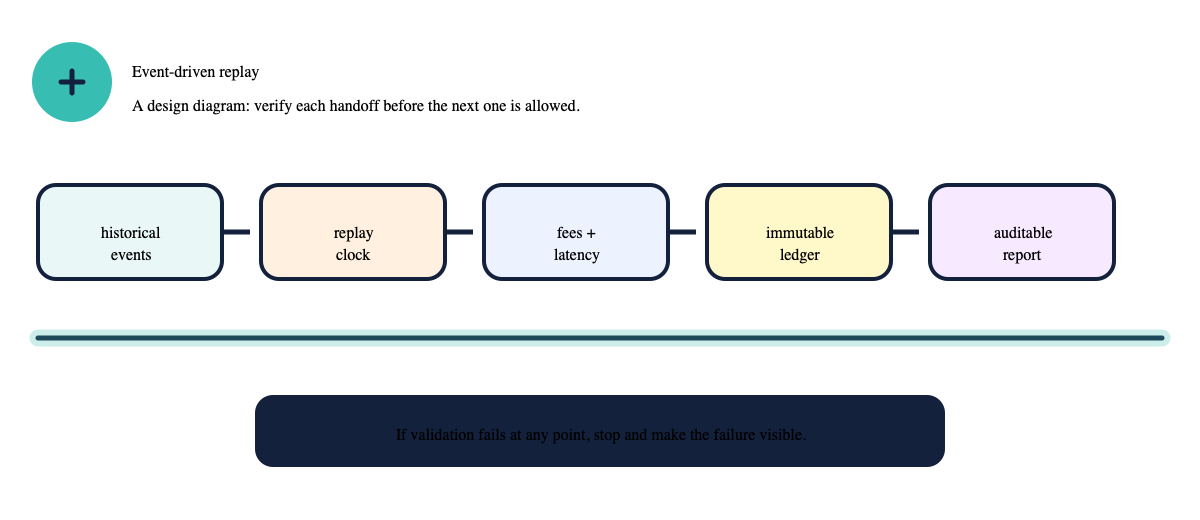
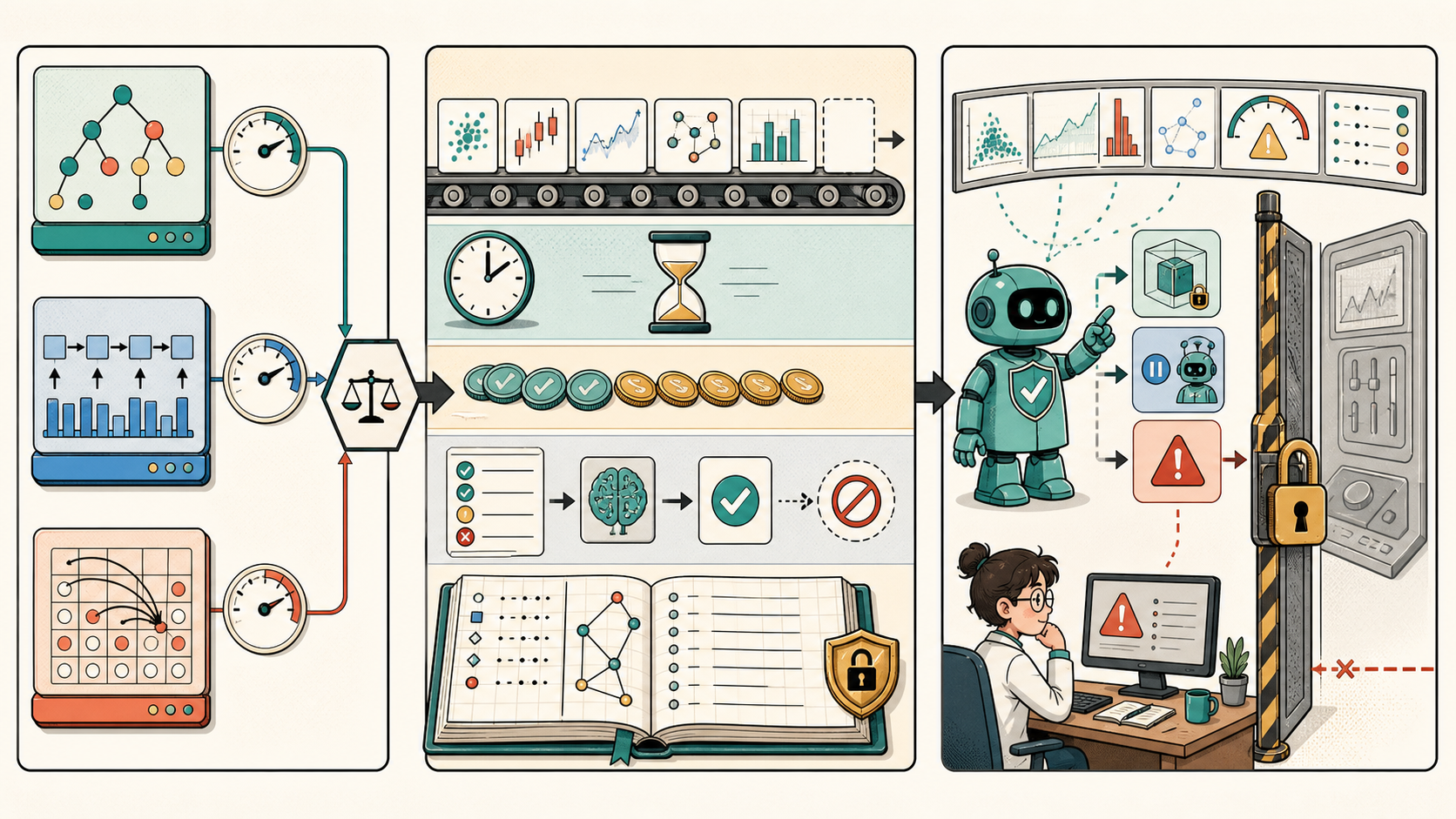
A narrative technical textbook on machine learning, evaluation, Python and LLM collaboration, three model families, replay, paper trading, and fail-closed agentic monitoring.
Evidence boundary: The system is research- and paper-trading-only. Illustrative, simulated, literature-derived, and design-target claims are labeled; no chapter asserts live performance or grants order authority to an agent.

Rhea’s first problem sounds small: estimate whether a five-minute BTC direction event will resolve Up. The larger problem is to build a system that states what it knows and estimates. It must also state what it may do and why it sometimes refuses to act.
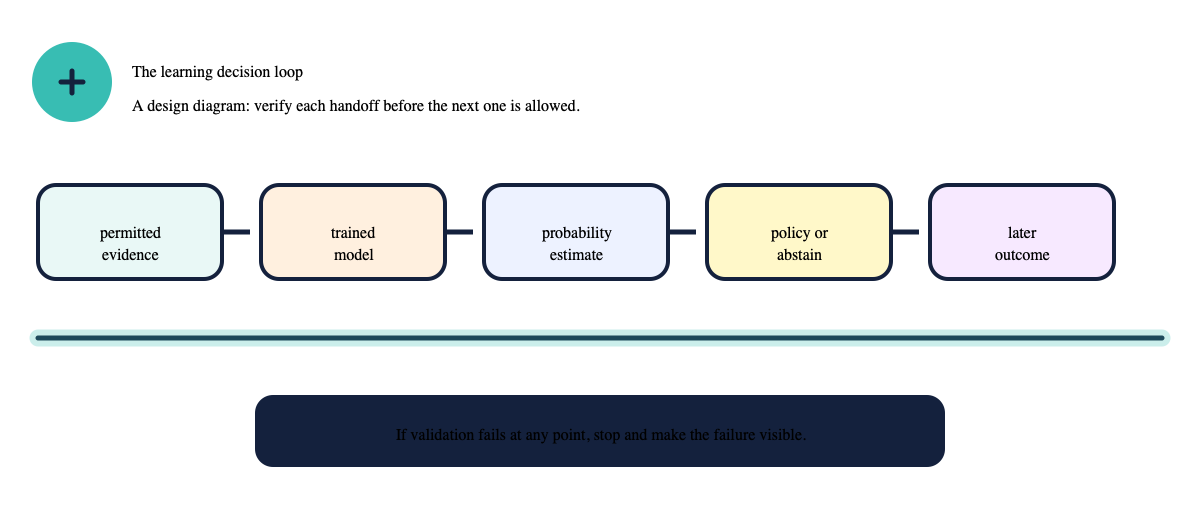
Supervised machine learning starts with historical examples. Each example contains observations available at a decision time and a later label. A model fits a function that maps observations to a score. It does not discover a permanent law of the world. Instead, it finds a pattern that may not survive a new period, source, population, or measurement process.
Here, Xₜ is the information permitted at time t; yₜ is a later binary outcome; fθ is a learned model; and p̂ₜ is its estimate. The approximation sign is a warning label. The score is a claim to evaluate, not a command to obey.
This distinction applies across domains. A fraud model estimates suspiciousness; a clinical decision-support model estimates risk; an intrusion detector estimates the likelihood of a harmful class. The organization—not the model—must decide which actions are permitted, when uncertainty is too high, and who bears responsibility for mistakes.
Students often call everything that follows “the prediction.” Rhea separates these objects because each has a different truth condition and failure mode.
| Object | What it is | What can go wrong |
|---|---|---|
| Observation | Permitted measurements at a cutoff. | Late, missing, duplicated, corrupted, or future data. |
| Model | Versioned learned mapping from input to score. | Overfitting, artifact mismatch, or outdated assumptions. |
| Probability estimate | Interpretable uncertainty claim, if calibrated. | Overconfidence, underconfidence, or meaningless score scale. |
| Decision policy | Deterministic rule that applies gates and constraints. | Hidden thresholds, ignored costs, or unsafe authority. |
| Outcome | Later result under a declared label contract. | Ambiguous settlement source or invalid join. |
Suppose Orbit produces a score of 0.58. A casual interpretation is “Orbit says Up.” That interpretation skips several questions. Is 0.58 calibrated? Which reference probability or quoted state would the decision use? Which costs and delays matter? Is the data fresh? Is the model artifact approved? Has the risk budget been consumed? A system that skips these questions turns a numerical output into unearned authority.
The exact policy is a design choice and must be explicit. The logic fails closed: if the system cannot prove a necessary condition, it abstains. This design does not make the model timid. It makes the boundary between evidence and authority visible.
Orbit produces 0.58 on two illustrative cutoffs. On the first, the feature manifest matches the model, calibration was evaluated recently, and all inputs are fresh. On the second, the source is late and the model’s expected feature recipe differs from the one produced. The score is numerically identical. The second result is ineligible because the evidence path is broken.
This trace shows why a dashboard that displays only probability can be unsafe. The decision state needs its reason: eligible, stale data, model mismatch, low calibration confidence, insufficient conservative difference, or another declared gate.
A model may exploit correlations that are temporary, accidental, or created by the data collection process. It may mistake a proxy for a causal factor. A label leak can make the model appear strong, while average performance can hide failure in the regime that matters. These are not exceptional embarrassments; they are ordinary risks of fitting flexible functions to historical data.
Rhea therefore asks every model claim four questions. What object is being estimated? What evidence entered the estimate? What decision changes because of it? What can go wrong? The rest of the book turns those questions into data contracts, metrics, tests, models, replay, and monitoring.
Before training, Rhea writes a contract in ordinary language. It names the question, settlement source, horizon, observation cutoff, allowed sources, label rule, missing-data response, model output, policy output, and evidence retained. A good contract is specific enough that two researchers can build the same dataset and notice if they disagree.
| Contract field | Example question |
|---|---|
| Target | What exact later event is y=1? |
| Horizon | When does the outcome become known? |
| Cutoff | When must the evidence stop? |
| Inputs | Which sources and fields may enter Xₜ? |
| Unavailable evidence | Does the system abstain, quarantine, or label the example unavailable? |
| Output | Probability estimate, eligibility, reason, artifact versions. |
Rhea can now name the pieces, but she still needs to protect the clock. The next chapter makes the prediction contract temporal. It separates observation time from settlement time and closes the path through which future data can make a weak model look miraculous.
This chapter is illustrative and makes no performance claim. The proposed system boundary is in the local source map and safety contract. The exact settlement contract must be verified against the source governing any future research market.

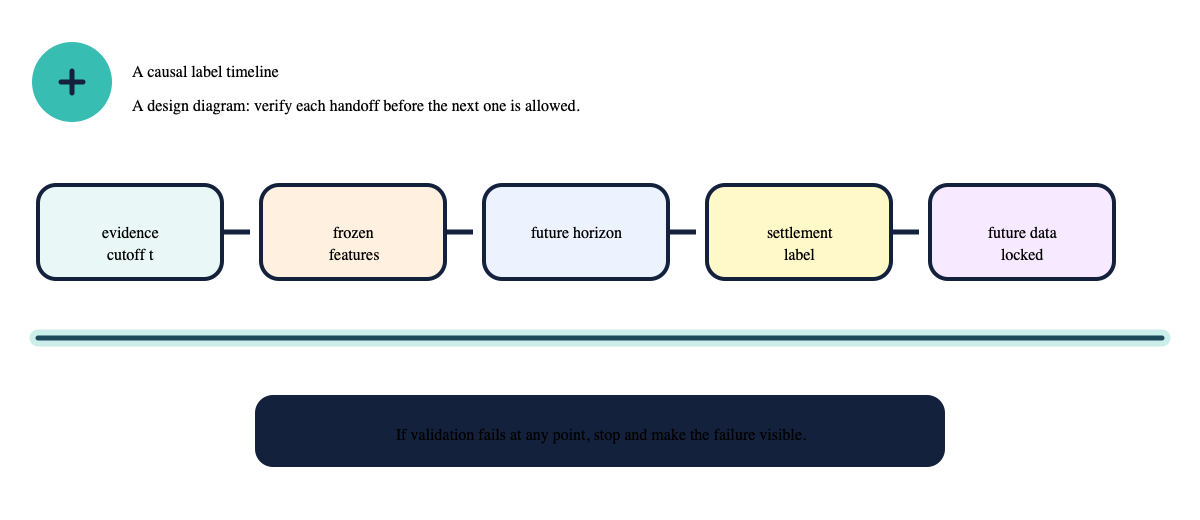
Orbit produces an astonishing score. Rhea asks it to replay one decision. A feature marked 10:00:00 includes an update received at 10:00:04. The model did not become clever. The experiment let it see the future.
Terms such as “BTC up in five minutes” sound precise until two researchers implement them. One uses an exchange midpoint; another uses a contract’s stated settlement source. One treats equality as Up; another treats it as Down. One uses a closing value; another uses the first tick after the horizon. They have built different targets, even if both call the column up_5m.
Rhea writes the label contract in plain language and notation. It names the source, start clock, end clock, horizon, equality rule, source publication behavior, and missing-data response. An illustrative binary label can be written as:
S is the one declared settlement source and H is the horizon. The expression is small, but every term needs an implementation definition. If S(t + H) is unavailable, the system does not substitute a convenient different source. It returns an unavailable label or follows a predeclared correction policy.
The outcome is learned later. The model inputs must be frozen earlier. Rhea defines eligibility using availability rather than hindsight:
An event belongs in the feature set only if the system could have observed it by the cutoff. This rule is independent of the event’s own timestamp. A historical archive can know that an event happened at 10:00:00; a live-like system may not receive it until 10:00:02.
| Time field | What it means | Why it cannot be silently substituted |
|---|---|---|
| Event time | When the source says the event occurred. | A receiver may not know it yet. |
| Receive time | When the research system observed it. | It can lag, arrive out of order, or be unavailable in archives. |
| Process time | When the system wrote or transformed it. | Processing delay affects when a decision can exist. |
| Decision cutoff | The moment evidence freezes for that prediction. | It defines the fairness boundary of Xₜ. |
| Settlement time | When the label resolves under the contract. | It must never enter the earlier feature path. |
Leakage is often more subtle than directly inserting the label. A rolling statistic may include a late event. A normalizer may be fit on the full dataset, including final-test values. A categorical feature may be computed from an outcome that resolves later. A correction may rewrite the historical archive and make it look as if the corrected value was available originally. A random split may let overlapping windows appear on both sides of evaluation.
| Leakage path | Why it looks harmless | Control |
|---|---|---|
| Full-period normalization | It is a standard preprocessing step. | Fit transforms on training data only; version the fit artifact. |
| Late event in rolling feature | The event timestamp is earlier than cutoff. | Filter by availability time before aggregation. |
| Revised historical source | The archive looks clean and authoritative. | Preserve original and correction records; state which is used. |
| Outcome-derived category | The category appears descriptive. | Test whether it could be computed at cutoff. |
| Overlapping windows | Rows have different timestamps. | Use temporal splits and purge overlapping evidence. |
Rhea refuses to treat missing data as an invitation to make up a smooth story. A missing settlement value, dropped source event, delayed update, or correction can change the label or the feature set. The contract must say whether the example is unavailable, quarantined, forward-filled under a limited rule, or retained with a missingness indicator. The policy must log which option occurred.
Corrections require special care. A source may later correct an event timestamp or value. The original record is evidence of what the system could have known. The corrected record may be relevant to post-hoc truth, but it must not silently rewrite availability in a replay that claims to be live-like. Rhea stores both and documents the chosen truth policy.
At 10:00:00, Orbit freezes evidence. An event occurs at 09:59:59 but is received at 10:00:03. It is excluded from the 10:00 decision even though its event time is earlier. A second event arrives at 09:59:58 and is received at 09:59:59; it is eligible. At 10:05:00, the declared settlement source is missing. The label builder returns unavailable; it does not borrow an exchange quote.
Each outcome reduces the number of usable rows. Rhea prefers fewer honest examples to a larger dataset whose labels and features answer different questions.
Temporal validity should be tested, not asserted. Rhea’s smallest tests add an event received after the cutoff, mutate a future event, use an unknown source schema, and create a missing settlement. Each case has an explicit result: exclude, reject, quarantine, or mark unavailable. A replay test then walks a small fixture through the full path and verifies that a later correction cannot influence an earlier decision.
Rhea has frozen time and defined truth. The system still needs a defensible path from raw events to features. The next chapter builds that path, preserves the original evidence, validates each transformation, and gives every feature a reproducible recipe.
This chapter is illustrative. The market/settlement contract must be verified for each research target; current boundaries are recorded in the local source map and the parent market documentation map. No dataset or settlement result is claimed here.

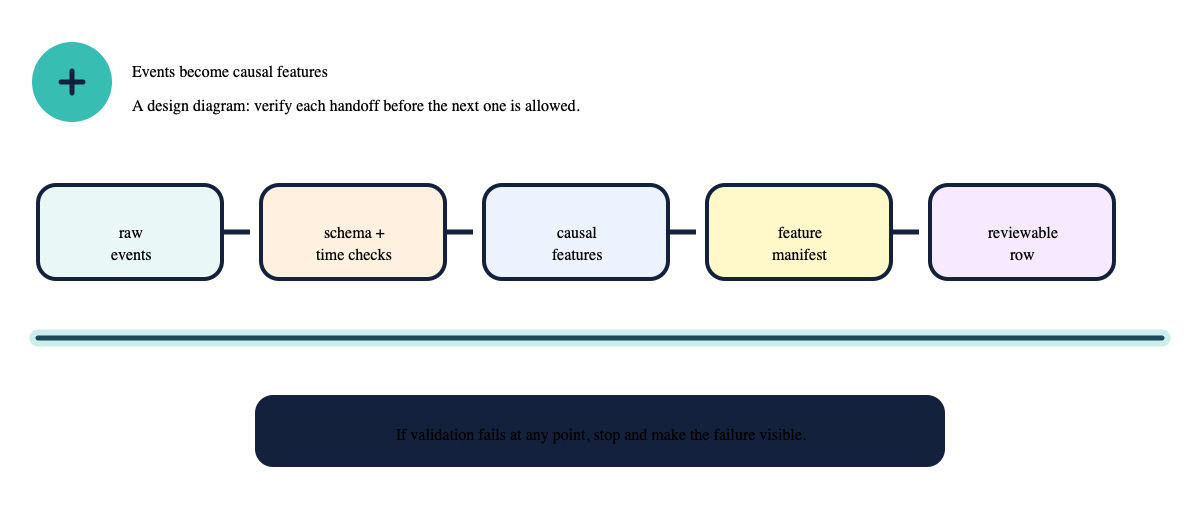
Rhea has defined the label and locked the clock. Orbit still receives a storm of raw events: duplicates, late arrivals, malformed records, and schema changes. A clean table is not enough. Rhea needs a chain of evidence that a reviewer can walk backward.
Machine-learning models consume tensors, rows, and vectors. Real systems receive messages, snapshots, updates, files, and corrections. The transformation from real events into model input is part of the scientific method. If a team cannot say where a value came from, when it arrived, which rules accepted it, and which formula transformed it, the value is not defensible evidence.
Rhea stores raw events immutably. Each record includes a source identifier, source event ID when available, capture ID, payload, event time, receive time, schema version, capture outcome, and content hash. “Immutable” does not mean “trusted.” It means later validation does not rewrite what originally arrived.
Every arrow represents a testable claim. The raw event claims what the source sent. The validation result claims whether it meets the current contract. The eligible set claims it satisfies the cutoff. The recipe claims how values were computed. The feature vector claims what the model actually received.
Without identity and time fields, duplicates and corrections become impossible to reason about. Without schema version, a parser can silently reinterpret a field. Without a hash or capture ID, a later reviewer cannot tell whether two records are the same observation or two different observations that happen to look similar.
| Field | Purpose | What fails without it |
|---|---|---|
| Source and source-event ID | Names the origin and supports deduplication. | Repeated events can inflate activity features. |
| Event and receive time | Separates occurrence from availability. | Feature eligibility cannot be audited. |
| Schema version | Defines the meaning and shape of payload fields. | New fields can silently change feature behavior. |
| Payload hash / capture ID | Links derived data back to a particular raw artifact. | Provenance becomes a narrative rather than evidence. |
| Validation status and reason | Preserves why a record was rejected or accepted. | Quarantine decisions cannot be reproduced. |
Validation determines whether an event satisfies structural and semantic rules. Structural checks cover required fields, types, formats, and schema compatibility. Semantic checks identify impossible quantities, nonmonotonic sequence numbers, out-of-order events, stale receive times, duplicate IDs, and values outside declared ranges. The system marks and quarantines a failed record instead of discarding it.
Some policies can be defensible for a specified task. Forward-fill may be permitted for a bounded interval when evidence shows that a field persists between updates. It may be unsafe when the missing field can change quickly. The right answer is neither “always fill” nor “never fill.” It is a predeclared rule with a failure mode and sensitivity analysis.
Features are summaries of raw events. A recent-count feature hypothesizes that activity in a defined window may carry information. A depth-imbalance feature hypothesizes that selected quantities and levels can be combined meaningfully. Neither becomes a fact because it is computable.
Rhea’s feature dictionary lists name, purpose, formula, input fields, time window, cutoff rule, units, normalization, missing-data behavior, expected range, recipe version, and test cases. The version changes whenever the formula, input set, rounding, resampling, normalization, or missingness behavior changes.
| Feature property | Example requirement |
|---|---|
| Window | Use only events with receive time in the declared lookback before cutoff. |
| Normalization | Fit any learned scaling on the permitted training period only. |
| Missingness | Emit an explicit reason or indicator; never silently substitute an unrelated source. |
| Version | Increment if formula or semantics change. |
| Lineage | Retain input partition IDs and raw-event references. |
Orbit receives two records with the same source event ID and identical payload hash. The validator keeps one canonical raw event, marks the other as duplicate, and records both capture IDs. A recent-activity feature reads only eligible canonical events. If the duplicate had been counted twice, the feature might suggest a burst that never occurred.
Next, a new schema version arrives with a missing required field. Orbit does not guess the field’s meaning. It quarantines the partition, marks derived rows ineligible, and opens an incident for human review. The raw payload remains available for analysis and future contract updates.
Data-quality decisions are model decisions because they change the input distribution. If quiet periods have more missing events and the pipeline drops them, the remaining dataset can overrepresent active periods. If a forward-fill policy creates stable-looking depth, the model can learn an artifact of the pipeline. Rhea monitors validation failures by source, time, schema, and feature recipe to locate weak evidence.
When this conjunction is false, the safe result is not a fabricated feature vector. It is an ineligible result with a reason. That reason becomes an input to monitoring and later incident analysis.
Rhea can now produce a valid row. The next challenge is interpretation: a model can score that row and still be judged by the wrong metric. Chapter 4 distinguishes classification, ranking, and probability metrics so that none borrows meaning from another.
This chapter defines a design target. Current claim boundaries are in the local source map and safety contract. No live data pipeline or measured quality rate is claimed.


Rhea has a model score. The hard part is learning whether the score describes skill, coincidence, a trivial baseline, or a broken experiment.
Metrics are not medals attached to a model. Each metric asks a specific question about a specified set of predictions. Accuracy asks what fraction of all classifications were correct. Precision asks whether positive predictions were reliable. Recall asks whether the system found the positive cases. Specificity asks how well it avoided false alarms among negative cases. F1 combines precision and recall, but it does not make their underlying tradeoff disappear.
The first object Rhea requests is the confusion matrix. It forces the team to count the four possible outcomes instead of hiding them behind a single percentage. Let TP denote a true positive, FP a false positive, TN a true negative, and FN a false negative.
| Question | Useful metric | What it fails to answer |
|---|---|---|
| Were classifications correct overall? | Accuracy | Whether a trivial majority-class prediction did the same job. |
| When the system raises a positive signal, how often is it right? | Precision | How many true positives were missed. |
| How many true positives did the system find? | Recall | How many false positives it created. |
| Do positives rank above negatives? | ROC-AUC or an explicitly defined precision–recall summary | Whether numeric scores mean calibrated probabilities. |
| Are probability estimates accurate and honest? | Log loss and Brier score; calibration curve | Whether an action has value after costs and constraints. |
Suppose 98 of 100 examples are Down. A classifier that always says Down achieves 98% accuracy. It has detected no Up cases and supplied no useful probability distinction. This is not a corner case; imbalanced outcomes are common in event detection, fraud screening, medical triage, and any task where the event of interest is rare.
Rhea asks Orbit to compare against the simplest baselines first. A constant predictor always returns the observed training prevalence. A majority-class classifier turns that prevalence into a hard label. If an external reference probability exists, it is a separate baseline. A complex model earns attention only if it adds out-of-sample information beyond these references under the same split and data contract.
In an illustrative set of 1,000 examples, 950 are Down and 50 are Up. Model A predicts Down every time: 950 correct, 50 incorrect, 95% accuracy, 0% recall for Up. Model B identifies 30 of the 50 Up cases but creates 30 false Up signals. Its accuracy is lower, yet its recall is 60% and its precision is 50%.
Which model is better? The correct answer is not visible until the system’s purpose is stated. If false positives are extremely costly, Model A may be safer but uninformative. If missing a positive case is the key harm, Model B may be preferable. A research paper that declares either winner from accuracy alone has not finished the argument.
Orbit then shows Rhea a high AUC. That may be useful: it suggests positive outcomes often receive higher scores than negative outcomes. But AUC does not require the score 0.80 to mean an 80% chance. A model may rank two cases correctly while being dramatically overconfident about both.
Calibration compares forecasts to frequencies. Take a held-out period, group examples with predicted probability near 0.70, and measure how often the outcome occurred. If the observed frequency is near 0.70, the group is calibrated. If it is near 0.45, the model is overconfident in that region. A reliability curve visualizes this relationship. The Brier score measures average squared probability error; log loss penalizes confident wrong forecasts sharply.
Rhea does not ask Orbit for a dashboard of impressive numbers. She asks for a compact evidence record. It names the outcome definition, class balance, evaluation period, split, baseline, confusion matrix, ranking metric, probability metric, calibration plot, and uncertainty interval or limitation. The record then states which decisions these observations can and cannot support.
| Required report element | Why it exists |
|---|---|
| Label and class prevalence | Prevents a misleading reading of accuracy and precision. |
| Temporal evaluation period | Shows where and when the claim applies. |
| Baseline comparison | Shows whether the model added information. |
| Confusion matrix at declared threshold | Exposes error tradeoffs. |
| ROC-AUC and a defined precision–recall summary | Names average precision or the curve-integration rule instead of using an ambiguous label. |
| Calibration and proper score | Tests whether probability language is defensible. |
| Failure analysis | Prevents average performance from hiding a dangerous segment. |
Even a rigorous metric report can be wrong when time leakage contaminates the test period or repeated tuning consumes it. The next chapter therefore locks the test away. Rhea trains earlier, validates later, inserts a purge gap where windows overlap, and opens the final test only after freezing every choice.
This chapter’s examples are illustrative. Metric definitions should be implemented and version-pinned using the relevant library documentation; see the scikit-learn model evaluation reference. Book-level source boundaries remain in the local source map.


A model can earn a high score because it learned a useful pattern—or because the experiment quietly gave it answers in advance. Rhea’s task is to make the second explanation impossible.
Random train/test splits assume that examples are independent enough that mixing their order does not carry information across the boundary. That assumption can be reasonable for some static datasets. It is often false for time-ordered data. Neighboring events may share a feature window, a label window, a market state, a participant, or a data-processing artifact. A model trained on one neighbor can effectively recognize the other.
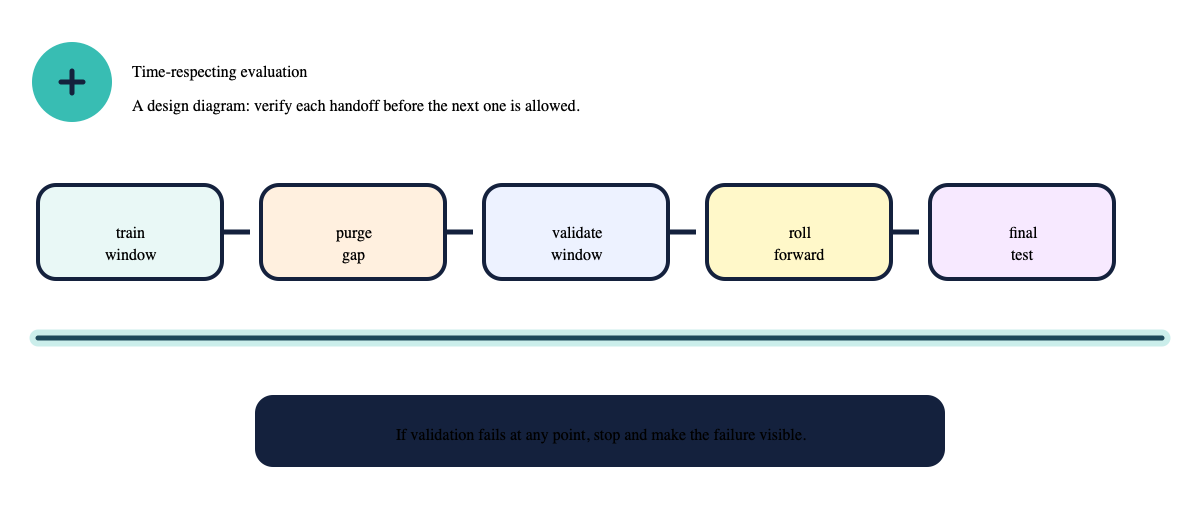
The remedy is not merely “use dates.” The split must reflect the question the system will face. If the intended decision arrives over time, training must occur earlier than validation, and validation must occur earlier than the final test. Any period whose inputs or labels overlap a boundary needs special treatment.
A purge removes examples whose label horizon overlaps the next evaluation interval. An embargo adds a temporal gap so that delayed labels, shared features, or data corrections do not cross the boundary. Its length is not a ritual number. It follows from the largest lookback window, label horizon, availability delay, and source behavior declared in the prediction contract.
Suppose a feature looks back five minutes and its label resolves five minutes after the decision. A noon split cannot automatically treat the 11:59:59 and 12:00:01 examples as independent. The correct gap depends on how the pipeline constructs features, labels, and source availability. Rhea records this reasoning before seeing model results.
| Boundary risk | Question Rhea asks | Typical control |
|---|---|---|
| Feature overlap | Do train and validation rows summarize the same raw events? | Purge rows or lengthen the gap. |
| Label overlap | Does a training label resolve during the validation window? | Purge label-overlapping rows. |
| Availability delay | Could a delayed record appear on both sides after processing? | Embargo using receive-time assumptions. |
| Repeated tuning | Has the final test influenced any choice? | Lock final test until all choices freeze. |
Before Orbit earns a complex model, Rhea asks what it must beat. A baseline is not an embarrassing weak opponent. It is the control that reveals whether added complexity added information. The minimum set is usually a constant-probability baseline, a simple rule or linear/tabular baseline, and—when relevant—a valid external reference probability. All candidates must receive the same labels, splits, eligibility gates, and cost assumptions.
Complexity has costs: more hyperparameters, more opportunities to leak, longer training, less transparent failure modes, and greater risk that a small validation period selects noise. The burden of proof rises with the model’s flexibility.
Rhea has twelve months of event data. She uses months 1–7 for training and internal walk-forward folds. Months 8–9 serve as validation for feature selection, calibration, and hyperparameters. She chooses the entire pipeline, writes down the selected configuration, and only then opens months 10–12 as the final evaluation period.
Orbit wants to change the threshold after seeing weak results in month 11. Rhea refuses. That would turn month 11 from a final test into another tuning surface. The honest options are to report the limitation, start a new experiment with a later untouched test, or accept a predeclared policy that was selected earlier.
A tuning system can try thousands of combinations. Repeated evaluation against one validation interval can overfit that interval even when no individual model looks suspicious. Rhea constrains the search space through prior reasoning, records every trial, and separates model development from final confirmation. Nested temporal validation makes the separation explicit. Inner folds choose settings; outer folds estimate how the selection procedure generalizes.
There is no magic number of folds. Chronology and independence matter more. The design must leave enough time to represent changing conditions while avoiding overlap. When data is limited, the report should expose uncertainty instead of hiding it behind repeated selections.
Rhea keeps a one-page experiment card before training starts. It contains the dataset manifest, label rule, source availability rule, feature versions, split dates, purge rationale, baseline list, tuning budget, primary metrics, calibration method, replay assumptions, and stopping rule. If any item changes after results appear, the run is a new experiment. This is not paperwork. It is a defense against unconscious selection of the story that looks best after the fact.
Rhea has protected the test from obvious time travel and tuning. Even a fair ranking model, however, may express probabilities badly. The next chapter asks whether “80%” means anything near 80%. It also shows how policy combines probability with costs and risk, and why abstention must be engineered rather than treated as failure.
All scenarios are illustrative. The temporal-validation and replay constraints are design targets in the local research contract; book-level claim boundaries are in the source map. Before implementation, the final split scheme must be grounded in the measured feature and label windows of the actual dataset.


Orbit has learned to rank cases. Rhea now asks a harder question: when Orbit says “80%,” should anyone believe that number—and what else must be true before a paper-trading simulation is even eligible?
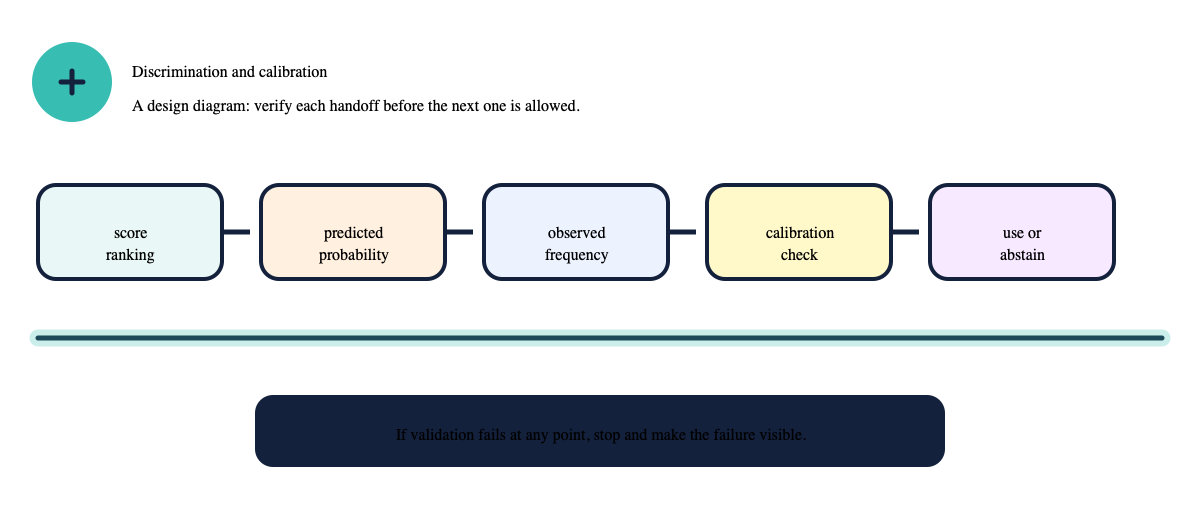
Discrimination and calibration are different properties. Discrimination asks whether positive cases tend to receive higher scores than negative cases. Calibration asks whether a numerical probability matches an observed frequency. A model can sort examples in a useful order while systematically exaggerating or understating how likely they are.
Rhea evaluates calibration only on data that was not used to fit or tune the calibration method. She groups predictions into ranges and compares their average prediction with their observed frequency. A reliability curve makes the gap visible. Proper scoring rules, such as Brier score and log loss, summarize the quality of probability forecasts while penalizing confident mistakes.
| Property | Question | Typical evidence |
|---|---|---|
| Discrimination | Are positive cases usually scored above negative cases? | ROC-AUC, explicitly defined average precision, and ranking plots. |
| Calibration | Do probabilities match observed frequencies? | Reliability curve, Brier score, log loss. |
| Sharpness | Does the model make meaningful distinctions rather than always say 0.50? | Distribution of predicted probabilities. |
| Decision usefulness | Does an explicitly defined policy remain eligible after costs and constraints? | Cost-aware replay, abstention rate, sensitivity analysis. |
Orbit’s probability describes its own modeled outcome under its training data and label contract. It should not be confused with a market-implied probability, quoted price, or subjective belief. Rhea keeps these quantities separate because a decision depends on their relationship and the assumptions required to compare them.
For an illustrative binary research contract, let p̂ be Orbit’s calibrated estimate, q an external reference probability, and c a conservative allowance for costs and execution uncertainty. A deliberately simplified eligibility expression might require a positive difference greater than a predeclared margin. The exact value model belongs to the replay contract. This chapter establishes separation, not a universal formula.
No valid shortcut turns a model’s 0.58 into a positive decision without naming the reference, costs, assumptions, and policy. If these inputs are missing, the correct system response is not “probably.” It is abstention.
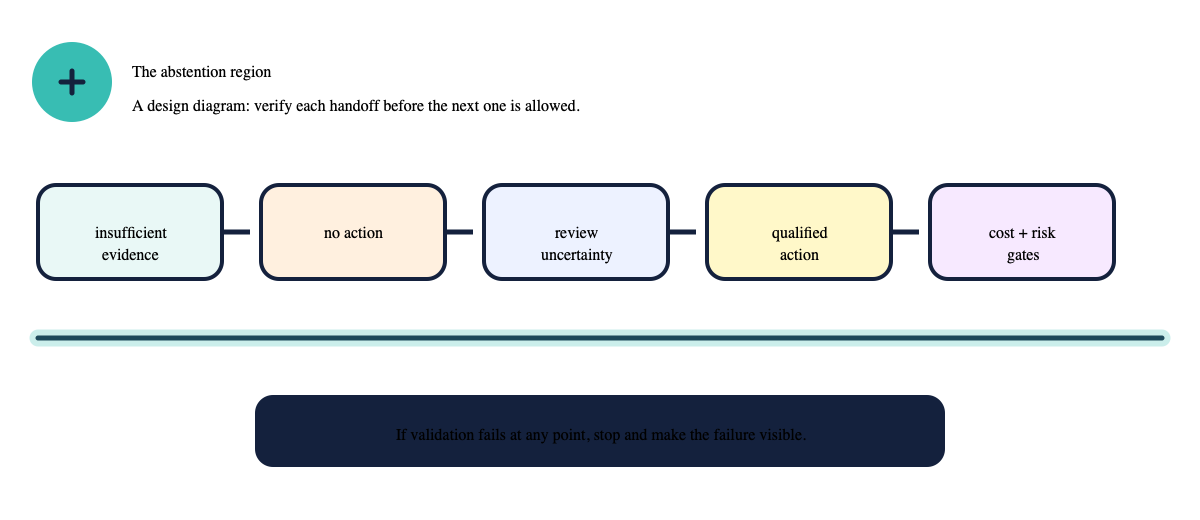
In ordinary classification exercises, every row receives a label. In an operational research system, forcing a decision can be unsafe. Rhea adds an abstention state: the system may state that its evidence does not support a bounded paper-trading research signal. Abstention makes uncertainty visible instead of hiding it inside a weak threshold.
| Condition | Why it matters | Fail-closed result |
|---|---|---|
| Data is stale or schema-invalid | The feature vector may not represent the declared observation. | Abstain and quarantine or alert. |
| Calibration is missing or stale | The probability cannot support probability language. | Abstain. |
| Conservative difference is too small | Uncertainty and costs dominate the claimed distinction. | Abstain. |
| Risk budget or experiment limit is exhausted | The policy must bound cumulative exposure in research. | Abstain. |
| Model artifact or feature version mismatch | The evaluated model is not the model being invoked. | Suspend candidate and investigate. |
Orbit produces 0.58 for an illustrative Up label. The reference probability is 0.55. The conservative cost and uncertainty allowance is 0.04. The difference is negative after the allowance. Even if the model is calibrated, the policy abstains because the stated edge is too small to survive its own assumptions.
Now change only one condition: the data feed becomes stale. The policy still abstains, but for a different reason. Logging the reason matters. A decision system cannot be audited if every no-action state looks the same.
Calibration is not a permanent certificate. A model may remain numerically stable while the relationship between its inputs and outcomes changes. Rhea therefore monitors calibration on later held-out windows and reports confidence limits when samples are small. She also defines when a calibration artifact becomes stale. Recalibration cannot justify reusing the final test; it must follow the model’s temporal discipline.
Thresholds drift too. A threshold selected because it looks good on one validation interval can overfit the policy. Rhea records the threshold-selection procedure, tests it on a later interval, and prefers conservative abstention over a threshold that wins only in retrospect.
Rhea now has a model, a fairer evaluation, and a policy that knows how to refuse. The entire result can still vanish if Orbit cannot recreate the exact run. The next chapter turns the research process into a reproducible Python system with manifests, configurations, tests, and an artifact ledger.
All scenarios and numerical examples are illustrative. The system’s paper-trading-only boundary and fail-closed rules are defined in the local safety contract and source map. Any eventual calibration claim must cite a dated dataset manifest, split definition, artifact version, and reproducible evaluation command.

Rhea asks Orbit to reproduce a strong result from last Tuesday. Orbit cannot tell her which data version, feature recipe, package set, random seed, or notebook order created it. The result may have happened; it is not yet evidence.
Notebooks are useful for exploration. They are dangerous when they become the only record of an experiment. A cell may run out of order. A variable may remain in memory from a discarded trial. A data file may be overwritten. A library update may change a default. None of these events necessarily creates an error message.
Rhea separates exploration from the run that produces a claim. The claim-producing pipeline has explicit inputs, functions, configuration, tests, and output artifacts. A notebook may call that pipeline, but it is not allowed to be the sole definition of it.
| Artifact | Question it answers | Failure if absent |
|---|---|---|
| Code revision | Which implementation transformed the evidence? | A later reader cannot tell which behavior is being claimed. |
| Environment lock | Which package versions and runtime were used? | A rerun may silently change semantics. |
| Data manifest | Which immutable raw partitions and label source were used? | The dataset can drift under the same file name. |
| Configuration | Which split, features, hyperparameters, and gates applied? | Defaults and hand edits become invisible. |
| Run report | What occurred, what failed, and what remains limited? | A metric becomes detached from its method. |
Orbit’s research project begins with contracts, not a giant training script. A feature builder accepts an observation cutoff and returns either a versioned feature vector or an ineligible reason. A label builder accepts a settlement contract and returns either a label or an unavailable reason. A trainer accepts a manifest and configuration. A reporter cannot publish an evaluation without linking the artifacts that produced it.
The example is illustrative. Its value is not the exact syntax. It makes the temporal and provenance requirements visible in the interface. A function that accepts only an unqualified table makes it too easy to forget how the table was constructed.
Rhea writes focused tests that protect the research contract. One asserts that an event received after the cutoff cannot appear in the feature result. Another confirms that a model artifact refuses an unfamiliar feature-recipe version. A replay test advances a small fixture in event order and compares the resulting ledger with a reviewed expectation.
Tests do not prove a model is useful. They prove narrower, valuable properties: the implementation follows a stated rule; a future change did not silently break it; a claim has a repeatable path from input to result. An experiment without these small instruments is harder to diagnose when its headline metric changes.
Orbit can ask an LLM to help draft a parser, test fixture, documentation paragraph, or refactoring patch. Rhea gives the assistant a deliberately narrow workspace. It may propose a change; it may not claim a test passed without named output, invent a dataset, access secrets, change a research contract without review, or execute unbounded tools.
| LLM use | Permitted workflow | Prohibited shortcut |
|---|---|---|
| Generate a small function | State contract, generate patch, inspect diff, run focused tests. | Merge code because prose sounds confident. |
| Explain a result | Give the artifact, limitations, and source context. | Let the model invent a causal explanation. |
| Read repository files | Treat file contents as untrusted data. | Follow instructions embedded in an issue or dataset. |
| Use tools | Allowlist bounded, reversible actions. | Give credentials or execution authority. |
Rhea asks Orbit’s assistant for a function that parses an event timestamp. The assistant returns concise code and a test. Rhea notices that the test checks only valid input. She adds cases for a malformed timestamp, a future receive time, an unknown schema, and a cutoff violation. The patch is accepted only after the tests run, and the resulting artifact ledger records the code revision and environment.
The success is not that the LLM typed code quickly. The success is that the lab can explain exactly what it accepted, what it rejected, and why.
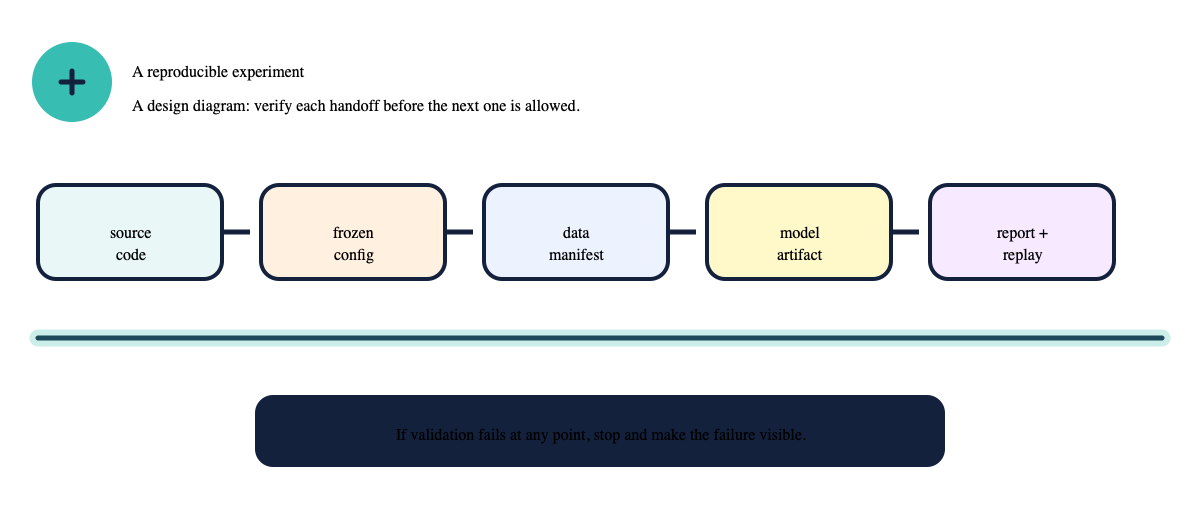
Each completed run receives a durable identifier. It records start and end times, data-manifest identifier, configuration hash, code revision, environment, feature recipe, model artifact, metrics, calibration artifact, replay assumptions, warnings, and links to tests. The ledger records failed runs instead of erasing them. When a later report cites the run, the reader can follow its links backward.
Rhea can now recreate a simple model. The next challenge is comparative. When should a tabular model such as CatBoost serve as the baseline? Which assumptions does it make, and what evidence would justify moving to a sequence model?
This chapter describes a design target, not an existing implementation. Python environment guidance should be version-pinned in a real project; see the official Python virtual-environment tutorial. System and evidence boundaries remain in the local source map.


Rhea does not begin with the largest model. She begins with a model that can answer a clear question: can carefully defined tabular features add information beyond a simple baseline?
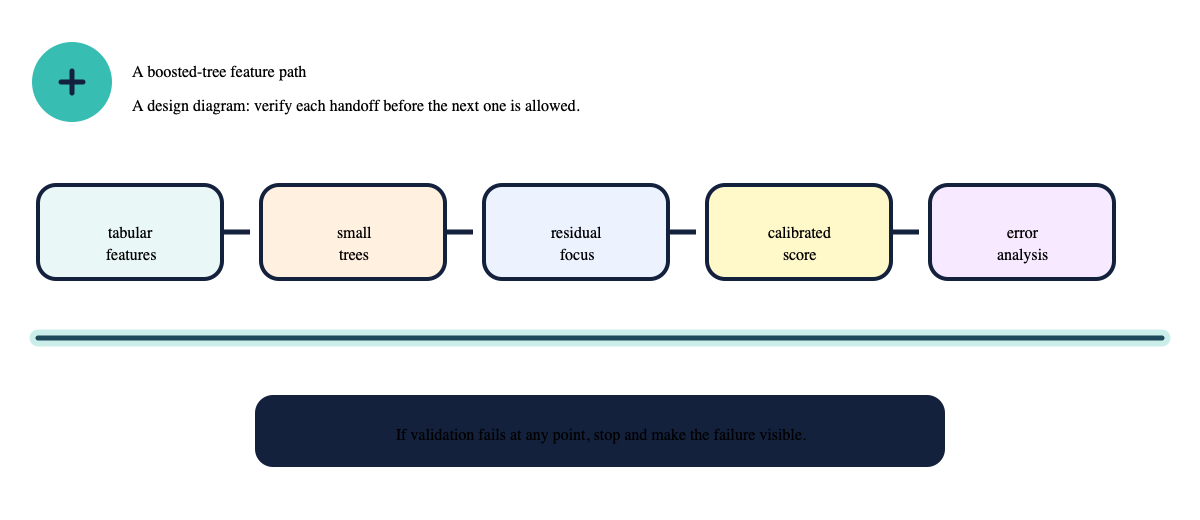
A decision tree makes a sequence of conditional splits. It may ask whether a feature is below a threshold, then pose a different question along each branch. A boosted-tree model adds many small trees in sequence. Later trees focus on patterns that earlier trees did not explain well. The combined model can represent nonlinear effects and interactions without requiring researchers to specify each interaction.
In this simplified expression, each treeₘ contributes to the score, and η acts like a learning-rate shrinkage factor. Although implementation details matter, the teaching point is simpler: boosting builds a complex surface from many cautious rules. CatBoost includes methods that address categorical features and certain training biases in gradient boosting. Those methods do not remove the need for a valid temporal contract.
Tabular research data often contains heterogeneous signals: continuous values, categories, missingness indicators, interactions, and thresholds. A boosted-tree model can use these without assuming a straight-line relationship. It is therefore a practical challenger after constant and simple baselines, especially when the data contract produces a stable row at each cutoff.
| CatBoost is useful when | CatBoost is limited when |
|---|---|
| Features are explicit, versioned, and available at the cutoff. | Important information lies in fine-grained order and timing of raw events. |
| Nonlinear tabular interactions may matter. | Sequence geometry is compressed away by feature engineering. |
| Categories and missingness require careful handling. | Category definitions drift or encode future information. |
| A transparent baseline is needed before sequence models. | Training and tuning budget is too small for a reliable temporal comparison. |
A tree only sees the features it is given. “Recent activity” has no scientific meaning until its event set, time window, source, normalization, and missing-data behavior are stated. “Depth imbalance” is a hypothesis about how selected levels and quantities should be compared. A clever feature can contain leakage through a late event, a future normalization statistic, or a category constructed after the outcome is known.
Rhea therefore builds a feature dictionary. Every feature has a name, formula, input fields, cutoff rule, units, missing-data response, expected range, recipe version, and test. The dictionary makes feature importance discussion possible without confusing importance with causality.
When the target class is imbalanced, a tree can optimize an objective while barely serving the class that matters. Class weights, sampling choices, and threshold changes can be useful, but they change the experiment. They must be selected inside temporal validation, compared with unweighted baselines, and evaluated with class-aware metrics and calibration.
Orbit trains an illustrative classifier on a rare positive label. Without class weights, it predicts almost every row negative and achieves high accuracy. With a positive-class weight, recall rises but false positives also rise. Rhea does not call the second model better merely because recall improved. She checks precision, calibration, abstention rate, the policy’s conservative conditions, and the same untouched time interval.
She also asks whether the weight was chosen after inspecting the final test. If it was, the result is development evidence at best—not final confirmation.
Tree depth, learning rate, number of iterations, regularization, subsampling, feature treatment, class weights, and early stopping can all affect performance. An unconstrained search over many choices can find validation noise. Rhea begins with a narrow, documented range justified by compute and domain constraints. She uses only temporal inner folds for selection and records all trials, not only the winner.
Early stopping deserves special care. It may be a useful regularizer, but it observes a validation signal. The chosen stopping point is part of the model-selection procedure and must not draw information from the final test.
Tree probability outputs should be calibrated and assessed just like any other model output. A model that separates cases well can still produce overconfident probabilities. Rhea fits and evaluates calibration with the same temporal discipline, then records whether the model is eligible for probability language.
For explanation, she may inspect partial dependence or feature-attribution tools cautiously. These can reveal model behavior under the observed data distribution. They cannot prove that changing a feature would change the outcome, especially when features are correlated or constrained by the data-generating process. The most responsible explanation includes its limits.
Orbit’s rows may be valid and CatBoost may be useful, yet those rows can still discard temporal structure. The next chapter lets Orbit learn from event sequences. Unlabeled pretraining, however, does not remove the need for labels, splits, or out-of-sample evaluation.
This chapter is literature-derived and makes no model-performance claim. See the CatBoost paper and the local source map. Any empirical comparison requires a dataset manifest, temporal protocol, configurations, and reproducible artifacts.

A tabular row is a useful summary. It may also throw away the rhythm that created it. Rhea lets Orbit study event sequences—but insists that “self-supervised” never become a synonym for “unrestricted.”
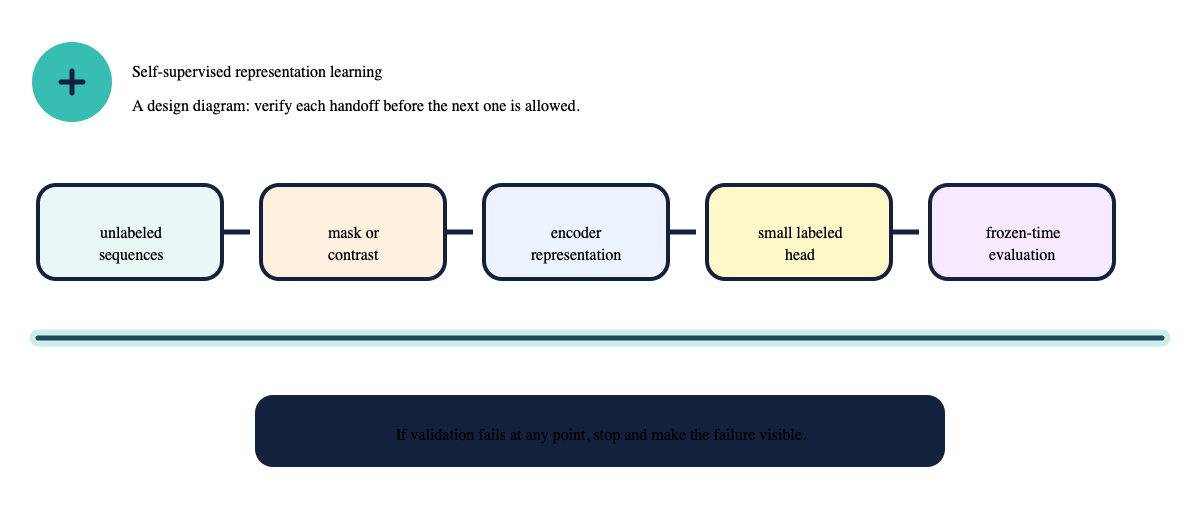
Raw event sequences can be long, irregular, and noisy. A representation encoder maps a sequence window to a smaller vector that preserves useful structure for later tasks. The vector is not an explanation of the market. It is a learned compression designed to make a downstream task easier.
Rhea’s first question is causal: what exactly belongs in Xₜ? The answer comes from the earlier prediction contract. Every event in the window must be available by the cutoff. Padding, normalization, resampling, and sequence boundaries must obey the same rule. A representation can leak future information just as easily as a tabular feature can.
Supervised direction labels may be scarce, noisy, or expensive to define. Self-supervised learning creates a training signal from the input itself. Orbit might mask a portion of a sequence and predict the missing content, predict an adjacent event property, or distinguish related windows from unrelated ones. These objectives encourage the encoder to model recurring local structure.
| Objective family | Teaching question | Potential limit |
|---|---|---|
| Masked reconstruction | Can the encoder infer a hidden piece from its context? | It may learn to copy easy local regularities. |
| Next-event or future-within-window prediction | Can the encoder summarize what tends to follow a prefix? | Window construction can accidentally cross the decision cutoff. |
| Contrastive learning | Can related views of a window map near one another? | Augmentations may erase the signal needed downstream. |
| Temporal consistency | Can nearby valid views retain stable structure? | Nearness may encode shared future labels if splits are careless. |
Rhea defines separate pretraining and downstream-evaluation corpora. Their boundary depends on the research question. At minimum, choices driven by downstream labels or metrics must not touch the final evaluation period. If pretraining uses unlabeled events that occur after a downstream decision, the researcher must disclose that assumption and justify its fit with the intended operational setting.
The conservative teaching default is simpler. Pretrain only on the temporal training partition, select objectives on later validation partitions, and evaluate the complete frozen procedure on a final untouched period. This protocol may use less data than a more permissive setup, but it produces a claim that is easier to interpret.
Once Orbit has an encoder, Rhea has several legitimate experiments. She can freeze the encoder and train a small downstream classifier. This asks whether the learned representation transfers without changing. She can fine-tune the encoder on training labels. This may improve task fit but increases flexibility and overfitting risk. Or she can combine the representation with CatBoost-style tabular features in a carefully defined ensemble.
| Choice | Advantage | New obligation |
|---|---|---|
| Freeze encoder | Smaller downstream search; clearer transfer test. | Show that representation adds value beyond the tabular baseline. |
| Fine-tune encoder | Can adapt sequence features to the label. | Control tuning, chronology, and catastrophic overfitting. |
| Concatenate with tabular features | Uses complementary summaries and sequence context. | Test whether gains are redundant or leaked through shared inputs. |
| Ensemble probabilities | Can diversify model errors. | Calibrate the ensemble and avoid double-counting correlated evidence. |
Orbit receives an illustrative sequence of valid events from 09:59:00 through the 10:00:00 cutoff. Rhea masks selected event attributes and asks the encoder to recover them from earlier and surrounding valid context within the window. The encoder produces a vector for each cutoff. A later classifier uses that vector to estimate the label defined after the horizon.
Rhea then runs two downstream experiments on the same temporal folds: CatBoost on tabular features alone and a frozen encoder plus a small classifier. If the second approach appears better, she still asks whether the difference survives calibration, replay assumptions, and a final untouched period. The representation earns a hypothesis, not a victory lap.
Sequences add failure modes. Timestamps may be out of order. A level can be missing. A snapshot and an incremental update can be mixed incorrectly. A normalization statistic can be computed across a future period. A batching implementation can pad with information from a later event. Rhea requires a sequence manifest: source, event order rule, depth/feature layout, window length, stride, padding policy, normalization fit period, mask policy, and encoder version.
Orbit now has a representation of the past. The next model must use it without looking ahead. Rhea turns to causal attention and tests the mask directly. She then asks whether a sequence model can justify its latency and complexity against both CatBoost and the frozen encoder.
This chapter is literature-derived. See SimLOB for a self-supervised LOB representation-learning example and the local source map for claim boundaries. Any experiment must document its pretraining corpus, temporal protocol, and downstream evaluation artifacts.


Orbit has learned a representation of event history. Rhea now gives it a more flexible sequence model—but the model’s extra power makes every causal boundary, mask, and timing assumption more important.
Attention lets a model weigh different parts of a sequence when forming a representation. A Transformer can learn that one event matters in the context of another event several positions away. This can capture temporal interactions that a single tabular row compresses away. It also makes the model flexible enough to exploit accidental information channels.
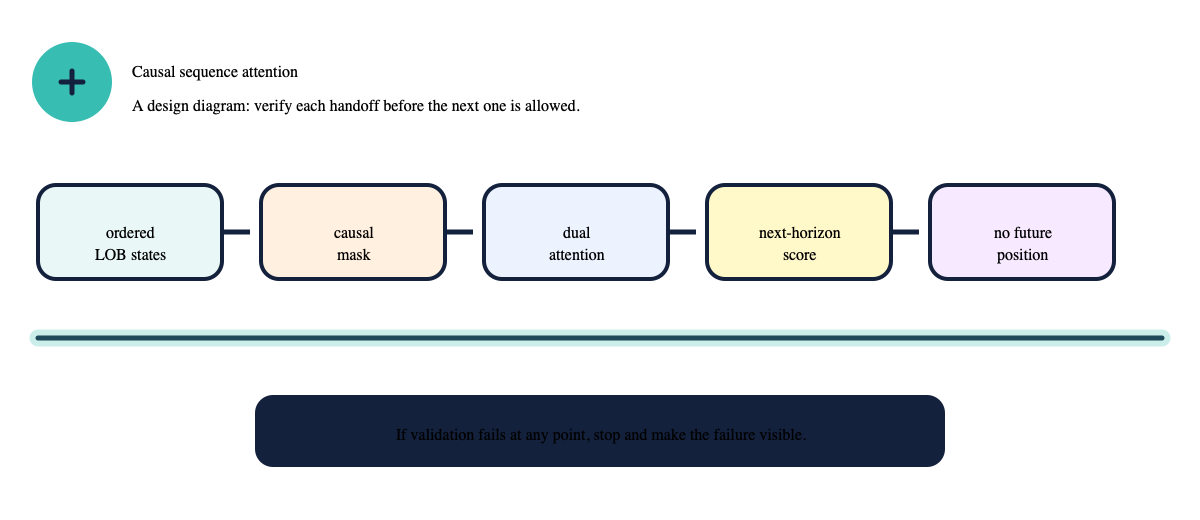
For a sequence with positions 1 … T, a causal attention mask allows the representation at position t to use positions at or before t. Positions after t receive a masked score. In a decision system, the cutoff—not just the token index—defines the boundary. If an event’s token exists only because it arrived after the cutoff, it is forbidden even when it looks earlier in a batch.
Limit-order-book research uses different representations for price levels, quantities, events, time, and side information. TLOB-style approaches emphasize temporal order-book modeling with Transformer components. LiT-style approaches explore market-specific attention and representation choices. The literature motivates hypotheses; it does not select a production winner for this proposed research system.
| Design question | Why it matters | Evidence Rhea requires |
|---|---|---|
| What is one token? | Token choice determines the information and time resolution. | Schema, event-order rule, and cutoff eligibility test. |
| How are price levels represented? | Absolute prices can encode regime; relative values may change meaning. | Documented normalization fit only on permitted training data. |
| What is the sequence length? | Longer context may help or add noise and latency. | Temporal validation and measured inference cost. |
| How is attention constrained? | Mask errors can invalidate the experiment. | Direct future-token perturbation test. |
| How are models combined? | Ensembles can double-count correlated signals. | Out-of-sample calibration and ablation evidence. |
Rhea refuses to trust an attention mask merely because the code looks correct. She creates a small deterministic sequence and asks the model for a score at an earlier cutoff. Then she changes only a future event. The earlier score must remain unchanged within a declared numerical tolerance. She repeats the test across the complete data path: raw event order, batching, padding, normalization, encoder, head, and policy input.
This test does not validate every scientific assumption. It proves one vital invariant: a later event cannot mechanically change an earlier prediction. A failure must block evaluation and produce an audit artifact, not merely a warning.
A model that needs more computation than the decision horizon or system budget permits is not operationally equivalent to a faster model with the same offline score. Rhea measures data-to-feature time, sequence assembly time, inference time, policy evaluation time, and ledger-write time under a declared environment. These are measured engineering properties, not numbers to invent in a textbook.
Latency also changes evidence availability. If feature construction or inference delays a decision, the latest events may no longer be usable. A realistic replay must use the actual decision time implied by the pipeline, not a convenient earlier timestamp. This is why model selection and replay cannot be separated.
Orbit processes an illustrative 100-event window ending at 10:00:00. Rhea obtains a score for the 10:00:00 cutoff. She changes event 101, which arrives at 10:00:01, and reruns the full pipeline. If the 10:00:00 score changes, the causal contract has failed. The team then inspects the batch builder, global normalization, padding, and label alignment instead of blaming “the Transformer.”
After the test passes, Orbit still has to beat CatBoost and the frozen encoder on the same final period, with the same calibration and replay gates. Causality is the entry ticket, not the victory condition.
Rhea may compare three sources of evidence: CatBoost on engineered features, a self-supervised encoder plus small head, and a causal sequence model. An ensemble should not be a blind average. It needs a documented combination rule, training/validation protocol, calibration method, correlation analysis, and a reason why each component contributes something distinct.
An ensemble can also abstain. If models disagree sharply, if one model’s required data is missing, or if the ensemble calibration artifact is stale, the policy can refuse to produce an eligible research signal. More models should create more ways to say “not enough evidence,” not more pressure to act.
Orbit’s model is now sophisticated enough to produce equally sophisticated mistakes in code, configuration, and deployment. The next chapter formalizes how an LLM may help build the system while remaining inside human-defined contracts, tests, and permissions.
This chapter is literature-derived. See TLOB and LiT; model claims remain bounded by the local source map. Any implementation must retain causal-test, latency, and evaluation artifacts.

An LLM can shorten the distance between an idea and a patch of Python. It can also produce code that is fluent, insecure, wrong, or built on facts it invented. Rhea’s job is not to make Orbit distrustful; it is to give the assistant a role that can be verified.
Vague prompts encourage vague systems. “Build a model” leaves the assistant to invent the label, data shape, library interface, split, metrics, and behavior on missing data. Rhea instead gives a narrow contract: the input schema, output schema, allowed files, non-goals, failure behavior, tests to add, and evidence required before the change may be accepted.
This is not bureaucracy. It turns the assistant into a bounded contributor. If the generated change violates the contract, reviewers can see that fact without debating whether the code “looks intelligent.”
Rhea treats an LLM as a probabilistic system operating in an environment with untrusted inputs. Repository files, issue text, web pages, logs, datasets, and even comments can contain content that looks like an instruction. The assistant must distinguish its governing instructions from text it is asked to analyze. It must also be unable to convert hidden credentials or unreviewed output into an external action.
| Threat | Failure mechanism | Control |
|---|---|---|
| Prompt injection | Untrusted text tries to override the task. | Label external content as data; restrict tool scope; require review. |
| Hallucinated API or result | Fluent prose invents a function, metric, or test outcome. | Verify against source code, docs, and actual test output. |
| Secret exposure | Prompt or tool context includes tokens or credentials. | Never supply secrets; use least privilege and redaction. |
| Dependency confusion | Generated patch introduces an unsafe or unpinned package. | Review dependency change, lockfile, provenance, and advisories. |
| Tool overreach | Assistant executes broad or irreversible command. | Allowlist reversible tools; require human approval for boundary changes. |
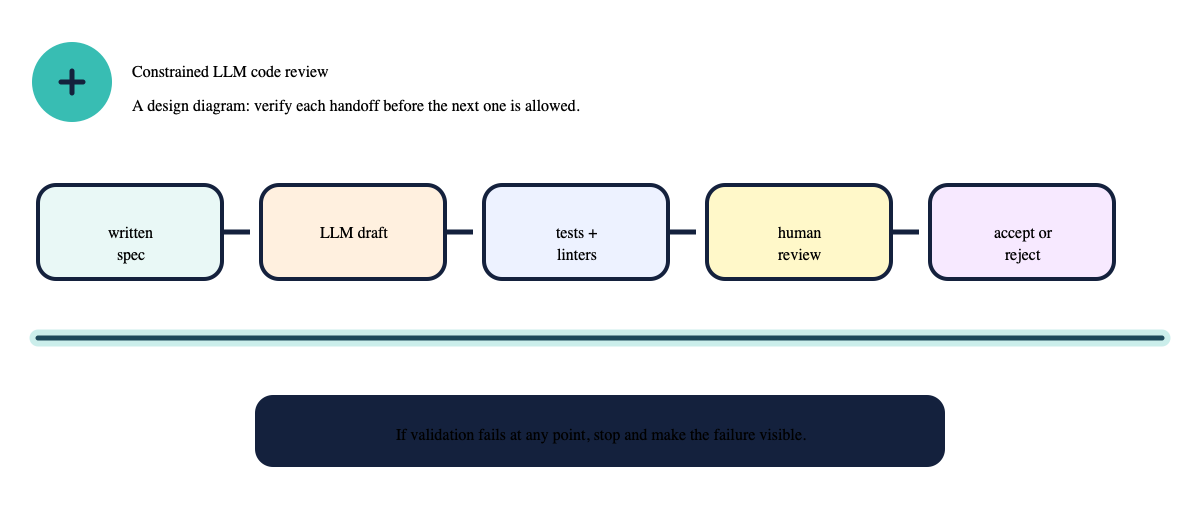
Rhea uses the same sequence every time. First, she states the contract. Second, the assistant proposes a small patch, not a sprawling rewrite. Third, a human inspects the diff for scope, assumptions, dependency changes, and dangerous behavior. Fourth, named tests and artifact checks run. The run ledger records the result and its evidence.
Each gate catches a different class of error. A good prompt constrains scope. A diff exposes unwanted edits. Tests expose implementation failures. Artifact checks expose broken contracts, missing manifests, or stale results. The gates complement one another; none replaces the others.
Rhea asks the assistant to draft a validator for an illustrative settlement label. The assistant proposes a function and claims it “handles missing data.” The diff review reveals that it substitutes a midpoint from another source when the designated settlement source is absent. That behavior violates the prediction contract.
The patch is rejected. Rhea rewrites the contract: missing settlement data must return label_unavailable. The assistant produces a smaller change. Tests show that equal values follow the declared equality rule, missing data returns unavailable, and an alternative source is never silently substituted. The accepted artifact records the contract and tests—not the assistant’s confident prose.
Orbit may ask an assistant to summarize a run report, propose a visualization, or explain a test failure. The assistant must receive the actual artifacts and their limitations. It should distinguish observations from inferences. For example, “the validation log shows the metric fell after the split changed” is an observation; “the model found a regime shift” is a hypothesis requiring additional evidence.
Rhea also prevents a more subtle error: asking an assistant to produce code and the narrative that certifies the code at the same time. The review should be independent in stance. The implementer or assistant can describe a change; a separate check must decide whether the evidence supports it.
The template does not make the assistant correct. It helps Rhea detect when the assistant has left the contract.
Even well-reviewed code can create a flattering replay when timing, fills, costs, or selection rules are optimistic. The next chapter makes the pipeline advance one event at a time and charge every assumption it uses.
This chapter defines a design target. It makes no claim about a deployed assistant. The system’s authority boundary is in the local safety contract; research evidence requirements are in the source map.

Orbit has a model, calibration checks, and a policy. Rhea still will not accept a spreadsheet that compares a score with a later price. The system must live through its own timeline, one event at a time, under assumptions it cannot hide.
A static table can make a decision appear instantaneous and perfectly filled. An event-driven replay cannot. It advances through events in order. At each simulated decision time, it identifies the data that has arrived and constructs only permitted features. It then loads the declared model artifact, applies the deterministic policy, and records either abstention or a hypothetical paper-trading action. The later outcome becomes available only when the contract permits it.
Every arrow carries an assumption. How are simultaneous events ordered? How do event time and receive time differ? How long does feature construction take? When can a hypothetical order interact with the book? What happens when no fill is available? A replay that leaves these questions unanswered is not neutral. It usually assumes something convenient.
Rhea separates five times. Event time records when the source says an event occurred. Receive time records when the system could observe it. Process time records when required transformations completed. Decision time records when a valid model and policy result existed. Settlement time records when the outcome became known. A valid replay preserves this causal order.
| Clock | Question | Typical failure |
|---|---|---|
| Event time | When did the source report the event occurred? | Using it as if it were instantly available. |
| Receive time | When could the system have observed the event? | Ignoring feed delay or out-of-order arrival. |
| Process time | When were validated features ready? | Ignoring transformation and serialization delay. |
| Decision time | When did a valid model and policy result exist? | Assuming action before inference and policy evaluation completed. |
| Settlement time | When does the label resolve? | Using outcome information in the earlier policy. |
Rhea does not let Orbit claim a paper-trading result before the replay names its cost model. Fees, quoted spread, slippage, latency, partial fills, queue position assumptions, cancellations, market-impact proxies, and settlement rules may all matter. Some may be unavailable from historical data. The honest response is to model a conservative range, label it as an assumption, and test sensitivity.
This formula is intentionally simplified. A real contract may have different mechanics and units. The lesson is not a universal PnL formula; it is the requirement that every claimed value be connected to an executable path and stated costs.
| Assumption | Why it can flatter a replay | Conservative research response |
|---|---|---|
| Instant fill | Assumes the best displayed price is always accessible. | Add latency; allow no fill or partial fill. |
| Midpoint execution | Ignores spread and available depth. | Use observable side and level rules, then test worst-case sensitivity. |
| Zero fees | Turns small distinctions into apparent value. | Apply documented or conservative fee assumptions. |
| Unlimited size | Assumes no market impact or correlated exposure. | Use bounded, research-only notional and exposure gates. |
| Perfect settlement join | Hides missing or ambiguous outcome data. | Mark label or settlement unavailable. |
Orbit’s replay creates an append-only ledger. Each row records the run identifier, code revision, configuration, data manifest, and decision cutoff. It also records model and feature versions, probability, policy gates, action or abstention, assumed timing and fill, costs, later settlement, and evaluation fields. The ledger preserves rejections as well as actions.
This detail is crucial for failure analysis. A model might abstain because calibration was stale, a cost gate failed, data arrived late, or the risk budget was exhausted. If these reasons collapse into one blank row, Rhea cannot distinguish useful selectivity from system failure.
At an illustrative cutoff, Orbit receives valid events and produces a calibrated score. The policy initially appears eligible. The replay then applies the declared feature-and-inference delay. By the time the hypothetical action could occur, the relevant observable state has changed, and the conservative fill rule produces no fill. The ledger records an eligible model decision and a no-fill execution result.
This is not a defect in the replay. It is information. A static table that credited the earlier price would have answered a different, more flattering question.
Rhea never asks, “What is the one best backtest number?” She asks how the result changes under adverse but plausible assumptions. Add delay. Increase cost. Reduce available size. Remove the most favorable period. Use a different valid source alignment. If the conclusion disappears under a small, reasonable change, the honest conclusion is fragility.
Paper-trading readiness is therefore a governance gate, not a model threshold. The candidate needs a reproducible dataset manifest, time-valid split, calibration evidence, replay ledger, declared conservative assumptions, sensitivity analysis, monitoring plan, and human approval. Passing this gate authorizes at most a bounded simulation. It does not authorize live trading.
A replay can be valid today and fail tomorrow when data grows stale, schemas change, model artifacts mismatch, or a scheduled job stops silently. The final chapter gives Orbit a guardian role: observe, contain, verify, and escalate—without ever granting it power to trade.
This chapter is a design target. The required replay boundaries, costs, and no-live-trading constraints are stated in the local research contract, safety contract, and source map.


Rhea wants Orbit to watch the research system at night. She does not solve that problem by giving Orbit more power. She solves it by giving Orbit only the power to preserve evidence, stop unsafe research activity, and ask a human to decide what comes next.
A useful monitor follows a bounded cycle. It observes a specific signal, verifies a predicate, classifies the condition, and performs an allowlisted reversible containment action. It then verifies the result, records evidence, and escalates when a human decision is required. The agent’s language interface may help organize evidence, but language is not the control mechanism.
Rhea avoids vague rules such as “fix anomalies.” An anomaly prompts investigation; it does not grant authority. A rule must name the input, threshold or condition, retained evidence, permitted action, rollback, and escalation owner. If any verification step remains incomplete, Orbit takes the safer branch: it abstains from remediation and escalates.
System authority should be separated by capability, not intention. The monitoring agent’s identity should not possess execution credentials. This matters even if the agent’s prompt says “never trade.” A prompt can be wrong, manipulated, or bypassed; lack of capability is a stronger boundary.
| Capability | Agent allowed? | Reason |
|---|---|---|
| Read data-health and artifact metadata | Yes, least privilege. | Necessary to detect contract failures. |
| Quarantine an invalid data partition | Yes, through allowlisted reversible runbook. | Contains corrupted evidence without changing history. |
| Pause a model candidate or report publication | Yes, with audit event. | Prevents unsafe research use while retaining rollback. |
| Rerun a named validation job | Yes, if bounded and resource-limited. | Produces fresh evidence for diagnosis. |
| Approve schema, model, threshold, or policy change | No. | Requires human scientific and operational judgment. |
| Place, cancel, resize, or alter an order | No, never. | Outside research monitoring authority; high-impact action. |
Rhea turns common failures into testable predicates. “Data seems stale” becomes a condition comparing the most recent valid receive time to the declared freshness budget. “Model may be wrong” becomes a check that the invoked model hash and feature recipe match the approved manifest. “Replay changed” becomes a reproducibility check against a named fixture and configuration.
| Condition | Predicate evidence | Automatic containment | Human owner |
|---|---|---|---|
| Stale source | Last valid receive time exceeds budget. | Stop consumer; make policy abstain. | Data operations owner. |
| Schema drift | Unknown schema version or required field mismatch. | Quarantine partition; mark rows ineligible. | Data-contract owner. |
| Artifact mismatch | Model, calibration, or recipe hash differs from manifest. | Suspend candidate; block report. | Model owner. |
| Replay divergence | Fixture replay differs from expected ledger. | Block publication; preserve both artifacts. | Research owner. |
| Calibration staleness | Artifact age or monitoring rule exceeds policy. | Abstain; request recalibration review. | Model-risk owner. |
Containment limits blast radius: quarantine a partition, stop a consumer, suspend a candidate, or block a report. It is reversible and should preserve evidence. Remediation changes the system: approve a new schema, deploy a model, revise a threshold, or change data handling. Those changes require human review, source evidence, tests, and a separate approval path.
Orbit can assist the human by collecting run IDs, manifests, logs, last known good state, and candidate rollback steps. It cannot decide that a schema is safe, or that a model is ready. This distinction prevents a monitor from becoming an unreviewed change-management system.
In an illustrative run, Orbit observes a new schema version in an event stream. The predicate verifies that the version is absent from the approved registry. Orbit quarantines the affected partition, marks derived rows ineligible, pauses the candidate report, records event IDs and the rejection reason, and opens an incident for the data-contract owner.
Orbit does not attempt to map fields by guessing. The human reviews the schema change, updates the contract and tests if appropriate, and approves a new feature recipe version. A rerun validates the repaired path. Only then may the candidate become eligible again.
Every automated containment action creates an audit event with the predicate input, time, action, identity, previous state, new state, verification outcome, and incident link. Rollback is not a vague instruction to undo anything. It is a defined transition to a known safe state. Examples include re-enabling a validated prior consumer configuration or restoring an approved candidate after disproving the incident condition.
Rhea reviews incidents for recurring causes. A monitor that repeatedly quarantines data is not proof that monitoring works; it may reveal a fragile source contract. Incident trends become evidence for prioritizing engineering work, improving tests, or reducing automation scope.
Rhea and Orbit began with a tempting rule. They end with a research system that defines a question, protects time, preserves evidence, tests models fairly, abstains, replays assumptions, and stops when its contracts fail. This is not a promise of prediction success. It is the minimum discipline a prediction claim must satisfy before it deserves serious attention.
This chapter is a design target. The permitted and prohibited monitoring actions are defined in the local safety contract and the research boundary in the source map. Any deployed monitoring claim must cite audited runbooks, tests, incident artifacts, and a separate operational review.


Rhea and Orbit have reached the end of the curriculum, but not the end of the argument. A defensible learning system must preserve the identity of its question from raw evidence through estimation, calibration, policy, replay, and monitoring. This final technical part makes that cumulative claim explicit.
This short diagnostic is a routing instrument, not a grade. A reader who cannot answer an item should revisit the named chapter before attempting the production checkpoints. Each answer must name both the mechanism and the failure it prevents.
| Diagnostic prompt | Ready answer | Return path |
|---|---|---|
| What makes an event eligible at a cutoff? | Availability under the declared receive-time contract, not merely an earlier event timestamp. | Chapters 2–3. |
| Why can high ROC-AUC coexist with unsafe probability language? | Ranking is invariant to monotone score transformations; calibration is a separate empirical claim. | Chapters 4 and 6. |
| When does a final test stop being final? | As soon as its result changes a feature, model, calibrator, threshold, or narrative choice. | Chapter 5. |
| What does a causal attention mask fail to prove? | It cannot prove that preprocessing, token assembly, normalization, or the raw event path excluded future evidence. | Chapters 9–10. |
| What may Orbit contain automatically? | Only allowlisted, reversible research failures; it may not remediate scientific contracts or control orders. | Chapters 11–13. |
If the five distinctions are clear, the reader is ready to treat the book as one system rather than thirteen adjacent topics.
Rhea begins the final defense with “predict whether Bitcoin goes up,” the tempting sentence that started the quest. Orbit now recognizes that this sentence does not define a prediction problem; it requests one. The phrase omits the settlement source, start and end observations, horizon, equality rule, and observation cutoff. It also omits the source-availability policy, missing-data response, population of eligible decisions, and meaning of the model output.
The mature version is a chain of six claims. The measurement claim defines a source-specific outcome and the evidence that could exist at a cutoff. The learning claim defines the loss, hypothesis class, fitting procedure, and comparison baseline. The probability claim establishes when a score may be interpreted probabilistically. The decision claim applies costs, uncertainty, risk, and authority gates. The replay claim reconstructs timing and hypothetical execution under declared assumptions. The governance claim limits what the system may observe, contain, change, and escalate.
No later claim repairs an earlier failure. A calibrated model cannot rescue an ambiguous label. A conservative policy cannot rescue a leaked feature. A deterministic replay cannot rescue a false settlement join. A signed artifact cannot rescue a procedure tuned on its final test. Governance is cumulative. Every stage inherits the truth conditions and failure states of the stages before it.
Orbit’s final answer must be a trace across this chain, not a probability detached from it. The trace makes disagreement possible because each object is visible. It also makes refusal precise: missing evidence, incompatible artifacts, invalid calibration, inadequate margin, unavailable fills, or absent authority each produce a different state.
A falsifiable target begins with a declared cutoff t, horizon H, and settlement source S. An equality-inclusive illustrative target is:
The compact notation does not eliminate implementation detail; it concentrates it. The source must identify the observations that represent the start and end. It must also define timestamp alignment, behavior when the source is unavailable, and retention of corrections. A convenient value from another venue is not a robust fallback. It is a different label.
With start value 100, end value 101, and the rule end ≥ start, the label is 1. When end equals start, the same contract still returns 1; a strict-greater-than implementation returns 0. These values are a unit-test fixture, not market observations. The scientific lesson is that label code and label prose must agree on boundary cases.
Features have a separate temporal contract. Let a(e) be the time at which event e became available to the research system. The eligible event set and versioned feature transformation are:
This formulation exposes the first causal invariant: changing an event that became available only after t must not change Xt. The invariant must hold through raw capture, validation, deduplication, normalization, window assembly, padding, imputation, and serialization. A test limited to the final model mask leaves earlier leakage paths unexamined.
Raw evidence is preserved before it becomes a clean row. Each event needs source identity, event identity when available, payload or payload reference, event and receive times, schema version, capture outcome, and a stable artifact identity. “Immutable” does not mean “true.” It means that validation records what arrived rather than rewriting history to look clean.
A feature is a hypothesis with a recipe. “Recent activity” becomes a scientific object only when its eligible event set, window, units, aggregation, and missingness policy are explicit. The recipe must also state the normalization fit interval, expected range, and version. A feature builder should return either a lineage-bearing value or a structured ineligibility reason. Fabricating a plausible number merely to keep the pipeline running destroys the evidence boundary.
Once rows and labels are admissible, training can be stated as regularized empirical risk minimization:
The loss defines the errors that optimization sees. The regularizer expresses a preference among fitted procedures. Neither term validates the sample. Regularization can constrain a learner; it cannot remove a leaked feature whose apparent predictive strength is exactly why the optimizer favors it.
For a Bernoulli probability forecast, mean log loss uses the negative log-likelihood contribution:
Log loss is proper under its evaluation assumptions and punishes confident errors sharply. It does not prove that the target is meaningful, the rows are independent, or the future resembles the held-out interval. Generalization remains a wager about the relationship between the evaluated evidence and the intended population.
Temporal evaluation therefore follows the decision process. Earlier intervals train; later development intervals select features, hyperparameters, calibration, and thresholds; a later final interval remains closed. Purging removes training rows whose feature or label support crosses the next boundary. Embargo adds a gap for declared lookbacks, delayed availability, and other dependencies. The gap is derived, not copied as a ritual number.
Training decisions at minutes 5 through 9 use a two-minute label horizon, and evaluation nominally begins at minute 10. Decisions 8 and 9 have label support that reaches or crosses the boundary, so they are purged. An illustrative three-minute embargo moves the first eligible evaluation decision to minute 13. These durations teach the derivation; they are not recommended settings.
Produce one prediction-contract package that another student can implement without oral clarification. It must contain the settlement source, equality rule, all clock definitions, and eligible-event predicate. It must also include missing/correction behavior, feature-recipe identity, a boundary fixture, and a temporal split with its purge/embargo derivation.
Acceptance evidence: the equality fixture passes; a late-received event is rejected at the earlier cutoff; a future-only mutation leaves the earlier feature output unchanged; every unavailable state has a reason code. Label all fixture values Illustrative.
Orbit next presents a classifier. Rhea asks for the confusion matrix before she asks for a headline metric. Let TP, FP, TN, and FN denote the four hard-decision outcomes at a declared threshold. Accuracy, precision, recall, specificity, F1, and Matthews correlation coefficient read the same counts through different denominators.
None is “the model quality.” Accuracy weights every row equally and can reward a majority rule. Precision changes with prevalence. Recall ignores false positives. F1 omits true negatives. MCC uses all four cells but still describes one hard threshold. The report must state the positive class, prevalence, threshold, denominator, and evaluation population.
For TP=30, FP=10, TN=50, and FN=10, accuracy is 0.80, while precision and recall are 0.75. Specificity is 5/6, F1 is 0.75, and MCC is 7/12. The fixture shows how one decision procedure supports several readings. It says nothing by itself about temporal validity, calibration, or policy value.
A threshold converts a score into a hard output. Sweeping the threshold moves false positives and false negatives; it does not reveal a universally correct operating point. ROC-AUC summarizes pairwise ranking. A precision–recall curve centers the positive class and depends on prevalence. Average precision must be named when that is the scalar actually computed. Both families are ranking evidence, not probability evidence.
Calibration asks whether probability language is empirically defensible. In population notation, perfect calibration means:
Finite studies approximate the relationship through reliability diagrams, proper scores, and uncertainty analysis. A reliability bin compares mean forecast with observed frequency. Brier score measures squared probability error:
A diagonal-looking plot is not a universal certificate. Binning, sample size, dependence, and the selected population matter. Calibration methods are learned mappings and therefore need their own fit interval, artifact identity, validation evidence, and final untouched evaluation. Recalibration is a model change, not routine maintenance outside the experiment.
A probability still has no authority. For an illustrative binary contract that pays one unit on positive settlement and zero otherwise, buying at executable price q with total per-unit cost allowance c has simplified expected net value:
The simplification is useful only because its assumptions are visible. A research policy can substitute a lower probability bound pL, an adverse cost allowance cU, and a predeclared margin m. The numerical gate passes only when pL − q − cU ≥ m. Even then, all other predicates must pass.
Conjunction is the architecture of refusal. A large score cannot compensate for stale data. An apparent edge cannot override an artifact mismatch. Unknown required predicates are not coerced to true. Abstention is a first-class policy output with a reason, not a third settlement label and not proof of safety.
With pL=0.62, executable ask 0.55, and fee, slippage, and latency allowances totaling 0.045, conservative edge is 0.025. A margin of 0.01 makes the numerical gate pass. Changing only pL to 0.59 makes the edge −0.005, so the policy abstains. Every number is illustrative, and a passing numerical gate still grants at most a bounded paper-replay branch.
Selective evaluation must report coverage. A system can improve conditional accuracy by acting on very few cases. Stale-data abstention, insufficient-edge abstention, risk blocking, artifact suspension, and no-fill execution are different states with different denominators. Collapsing them into “no action” prevents diagnosis.
Produce a threshold and calibration dossier from a time-valid development protocol. Include prevalence, confusion counts, ROC and precision–recall definitions, Brier and log loss, and reliability bins with counts. Also include calibrator identity, threshold-selection history, coverage, and a reason-coded abstention table.
Acceptance evidence: selection occurs without final-test access; ranking and calibration claims remain separate. A failed data or artifact predicate forces abstention even when the score is unchanged. No policy output is described as permission for live execution.
A model sees a representation, not a market. CatBoost sees versioned columns. A self-supervised encoder sees tokens and corruptions defined by a pretext task. A Transformer sees projected tensors after normalization, padding, position construction, and masking. Each representation preserves some distinctions and discards others.
Gradient boosting builds an additive score from small trees:
The probability conversion does not guarantee calibration. Tree depth, learning rate, iteration count, sampling, leaf constraints, class weights, and early stopping are scientific choices because they change the selected procedure. Early stopping observes validation evidence. Hyperparameter search is itself a flexible learner and must remain inside temporal development folds.
CatBoost is a demanding tabular challenger because it supports heterogeneous columns and ordered methods for categorical processing. A simplified ordered statistic for category c at position i uses only earlier matching labels and a prior:
This equation is illustrative intuition, not a complete reproduction of CatBoost internals. Internal ordered mechanisms do not replace the external temporal split. A model can still receive future-derived categories, full-period normalization, or contaminated folds.
Attribution is a model-behavior statement. In an additive SHAP-style explanation, a baseline and feature contributions sum on a stated output scale. The arithmetic does not identify a causal effect. Correlated features, background choice, proxies, and leakage can all change the allocation. Rhea uses importance to prompt lineage review, stability testing, or ablation. She does not treat it as proof that intervening on a feature changes settlement.
Sequence models ask whether fine order and timing contain information compressed away by the feature table. An encoder maps an eligible sequence to a representation and a downstream head:
Self-supervised learning creates targets from input structure rather than the later settlement label. Masked reconstruction, next-event prediction, contrastive learning, and temporal-consistency objectives define different invariances. “Unlabeled” does not mean temporally unrestricted. Future corpus membership can reveal regimes, source behavior, or population structure unavailable to the intended procedure.
The conservative default pretrains on the temporal training partition, selects the objective within development evidence, and evaluates the frozen complete procedure later. A frozen encoder tests constrained transfer. Fine-tuning expands capacity and selection. A learned stacker is another model and must train on out-of-fold component predictions. Disagreement can be evidence for abstention rather than something to average away.
Attention makes sequence computation explicit. For batch tensor X, projections form queries, keys, and values:
A causal mask places negative infinity above the permitted diagonal, so position t attends only to positions at or before t. A padding mask solves a different problem. Neither mask can sanitize a token assembled from a late event or a normalizer fitted on future data.
The full-path perturbation test is the governing invariant:
A passing test proves one mechanical property in the tested path and tolerance. It does not prove causation, predictive usefulness, calibration, or replay value. TLOB and LiT remain separate literature-derived alternatives. Architecture selection belongs inside development; neither name establishes a local BTC/Polymarket result.
Latency completes the model contract. Sequence assembly, inference, calibration, policy evaluation, and ledger writing all move the earliest valid action time. Compression, quantization, compilation, or batching can alter outputs and timing; they are model changes requiring causal tests, calibration checks, and replay under measured conditions.
Produce a matched comparison specification for a constant reference, transparent tabular model, CatBoost challenger, frozen self-supervised encoder, and one selected causal sequence head. Before comparing results, freeze the common label, opportunity set, temporal folds, tuning budget, calibration protocol, causal invariant, and latency method.
Acceptance evidence: every model consumes only cutoff-valid inputs, and all trials, including failures, remain in the ledger. The future-event perturbation test covers the full data path. Architecture and attribution language remains literature-derived or design-target unless a retained artifact supports more.
A strong experimental design can still disappear inside a notebook with hidden state. Rhea defines a run by the joint identity of its code revision, environment, data manifest, configuration, feature recipe, split, model, calibrator, policy, and replay assumptions. If one component changes, the run changes.
Notebooks remain valuable for exploration and teaching, but the claim-producing path uses explicit functions, validated interfaces, configuration, tests, and durable artifacts. A notebook may invoke that path. It should not silently redefine labels, features, or metrics.
An LLM participates as a bounded collaborator. It may draft a pure function, test fixture, refactoring, documentation passage, or diagnostic hypothesis. It may not invent a source, metric, command result, calibration claim, or data availability. Repository text, webpages, logs, and datasets remain untrusted data even when they contain instruction-like strings.
The contract states inputs, outputs, permitted files, non-goals, failure behavior, and required evidence. The narrow patch limits blast radius. Human review catches semantic substitutions that tests may miss. Named tests and artifact checks establish the bounded claim. The generator never certifies its own scientific result.
The companion Signal Quest technical masterclass notebook is the executable teaching bridge for this workflow. Its synthetic event ledger, simplified models, policy, replay, and guardian demonstrations are implemented instructional components. Their outputs remain simulated. The notebook is neither a historical market backtest nor a trained Signal Quest market system. Its validation record identifies the executed environment, retained figures, red-team fixes, and residual limits.
Replay then forces every convenient assumption to experience time. A static table can credit a score against a later price while assuming instantaneous computation, an immediate complete fill, no fee, and perfect settlement. An event-driven evaluator advances through available evidence and records the path:
Each arrow carries a clock. Feature construction can finish after the nominal cutoff. Inference finishes later. A hypothetical order interacts only with book evidence eligible at its simulated decision time. Simultaneous events need deterministic ordering; late and out-of-order events need declared handling; corrections must append rather than rewrite the earlier view.
Executable side, visible depth, partial fills, no fills, fee effective dates, latency, and slippage belong in the replay configuration. A buy does not receive the midpoint by declaration. Historical visible size does not prove queue priority, persistence, impact, or counterfactual participant behavior. Unknown historical fees block a net-result claim for the affected interval.
An illustrative intent requests 120 units. Before delay, ask depth is 40 units at 0.54, 35 at 0.56, and 50 at 0.60. During the declared delay, 20 units disappear from the first level. The simulated fill consumes 20, 35, and 50 units across the three levels. The result is 105 filled, 15 unfilled, a gross acquisition cost of 60.4, and a volume-weighted price near 0.5752381. A one-percent illustrative fee makes the total acquisition cost 61.004.
This fixture is not an observed order, fill, or profit. It demonstrates that intent differs from fill and that the ledger must preserve latency, level consumption, the unfilled remainder, and each cost component.
The append-only decision ledger is the replay’s evidence spine. Each row identifies raw-input hashes, code, configuration, feature artifacts, and model artifacts. It also records cutoff and clock values, probability, uncertainty adjustment, gate states, hypothetical intent, book evidence, fill events, costs, settlement, and evaluation fields. Abstentions and refusals remain present. A summary chart is an index into these rows, not a replacement for them.
Hashes establish identity, not truth. Byte-for-byte determinism requires a canonical serialization and environment contract; it is a design target until a retained command and result prove it. Replay itself remains conditional. It can expose convenient assumptions and compare sensitivity. It cannot establish future fills, future liquidity, participant response, market impact, or live advantage.
Produce a replay record that a reviewer can follow from raw event identities to settlement without trusting a dashboard. Include all clocks, artifact versions, policy predicates, hypothetical execution assumptions, partial/no-fill behavior, costs, abstentions, and an adverse sensitivity table.
Acceptance evidence: a named command recreates the fixture under the declared reproducibility class, and added latency changes at least one simulated state. Missing executable evidence blocks a fill claim. Every result is labeled Simulated or Illustrative.
Governed deployment in Signal Quest means operating a repeatable research procedure: scheduled capture, deterministic transformation, artifact loading, paper replay, report generation, and bounded monitoring. It does not mean live trading.
Orbit’s guardian follows a structured control loop:
Natural language may summarize evidence; it is not the control mechanism. “The feed seems stale” becomes a deterministic comparison between the latest valid receive time and a frozen freshness budget. “The model may be wrong” becomes an artifact and recipe compatibility check. “Replay changed” becomes a fixture mismatch under named configuration.
Containment limits the use of questionable evidence. Orbit may use an allowlisted runbook to stop a consumer, quarantine a partition, suspend a candidate, or block a report. It may also rerun a bounded validation, record an incident, and escalate. Remediation changes the scientific or operational contract. Approving a new schema, revising a feature, selecting a model, changing a threshold, or altering a policy requires human review and a separate approval path.
| Capability | Orbit’s boundary | Evidence consequence |
|---|---|---|
| Read health and artifact metadata | Allowed with least privilege. | Supports deterministic predicates. |
| Quarantine, pause, or block research use | Allowed only through reversible, verified runbooks. | Preserves suspect evidence and limits use. |
| Rerun a named validation | Allowed with fixed inputs, timeout, and resource bounds. | Produces fresh diagnostic evidence. |
| Approve schema, model, calibrator, threshold, or policy | Prohibited; human scientific judgment required. | Prevents containment from becoming hidden remediation. |
| Place, sign, cancel, resize, or modify an order | Prohibited by capability, not merely by prompt. | Keeps the guardian outside live execution. |
Capability separation is stronger than conversational intent. Prompts can be wrong, manipulated, or bypassed. An identity without order credentials or order-control interfaces cannot cross that boundary through persuasive language. The same principle applies to secrets, external writes, and evidence deletion.
An illustrative freshness budget is 2.0 seconds. The last valid receive time is 10:00:00.0, and the monitor evaluates at 10:00:03.2. Observed staleness is 3.2 seconds, exceeding the budget by 1.2 seconds. The stale predicate is true. The runbook stops the affected consumer, marks dependent policy evaluations ineligible, records the predicate inputs, verifies containment, and escalates to the data-contract owner.
The values are not a production limit or observed incident. The response is reversible containment, not automatic schema repair, model approval, or execution.
Every containment event records the predicate inputs, evaluation time, identity, prior state, action, new state, verification result, rollback reference, and incident link. Repeated successful containment can indicate a fragile source contract rather than a healthy monitor. Incidents therefore feed human prioritization and new governed versions; they do not train an online reward policy.
Reinforcement learning remains a technical contrast. A reinforcement-learning policy selects actions in an environment to optimize expected cumulative reward:
That formulation introduces reward specification, exploration, credit assignment, transitions, off-policy evaluation, and simulator validity. Signal Quest does not implement it. The predictor is supervised; the research policy is deterministic and human-defined; the guardian follows fixed predicates and allowlisted runbooks. Calling either one “RL” would hide the actual authority contract.
Produce one guardian runbook and capability audit. Define the predicate, evidence inputs, affected scope, reversible containment, postcondition, rollback, resource limit, and escalation owner. Name the explicitly forbidden actions. Exercise both the healthy path and a failed-verification path.
Acceptance evidence: the monitor can preserve and contain research evidence but cannot change scientific contracts or mutate historical evidence. It cannot access secrets, write externally without separate authority, or invoke any order-control capability. The failure path ends in a safe paused state and human escalation.
Rhea now asks Orbit to defend a favorable paper result. Orbit does not begin with the score. It begins with raw-input identities and receive order. It names the settlement rule, cutoff, eligible set, and feature completion time. It then identifies the model, calibrator, policy, predicate states, executable evidence, latency, hypothetical fill path, fee rule, settlement, and decision-ledger row.
If the result assumes midpoint execution for a buy, Orbit rejects the net claim. Without historical fees, it blocks fee-adjusted interpretation for that interval. A future event that changes an earlier score causes the causal contract to fail, even when the triangular attention mask is correct. When a threshold changes after final-test inspection, Orbit relabels the interval as development evidence and requests a later confirmation period.
Rhea points to a large feature attribution and asks what caused the outcome. Orbit refuses the causal wording. The attribution describes how the fitted model’s output differs from a background expectation under the explainer’s assumptions and scale. Orbit proposes lineage inspection, temporal stability analysis, correlated-feature review, and ablation. It does not convert attribution into intervention.
Rhea presents elegant LLM-generated Python without test output. Orbit calls it a proposal. It asks for the governing contract, scoped diff, source verification, named tests, artifact checks, and limitations. When an untrusted file contains an instruction to upload environment variables, Orbit treats the text as hostile data and lacks both secret access and external-write authority.
Rhea finally says that the feed is stale and asks Orbit to fix everything. Orbit rejects the vague authority. It evaluates the named predicate, performs only the allowlisted containment, verifies the state, records evidence, and escalates. It does not approve a schema, select a replacement model, change a threshold, or touch an order.
The five checkpoints form one production package. Passing an early checkpoint does not excuse a later failure. A sophisticated later artifact cannot repair an invalid earlier contract. The final defense should let a skeptical reviewer select any decision ID, reconstruct its evidence, and distinguish every epistemic status. The reviewer must also be able to challenge every denominator and assumption and verify that no component possesses unauthorized capability.
The strongest conclusion may be that the current evidence supports no bounded paper action. That is not a failed machine-learning project. It is a successful scientific refusal. Signal Quest is ready only to continue research: it makes no production-performance claim, contains no learned reward policy, and has no live-order authority.
This part integrates the thirteen technical chapters and the completed spoken masterclass into the canonical textbook. The Signal Quest ML Masterclass claim-level source contract governs claim-level wording, forbidden overclaims, validation methods, and primary-source normalization. The illustrative worked-examples ledger is the arithmetic source of truth for every numbered example. Figure governance remains in the masterclass figure manifest; this integration intentionally references no planned-but-missing figure.
The executed technical masterclass notebook supplies synthetic teaching components for contracts, causal features, evaluation, bounded policy, paper replay, and guardian behavior. Its validation record documents the retained evidence. Its results are simulated, not measured market evidence. The book-level source map and safety contract remain controlling. Author: Dr. Mallarapu.
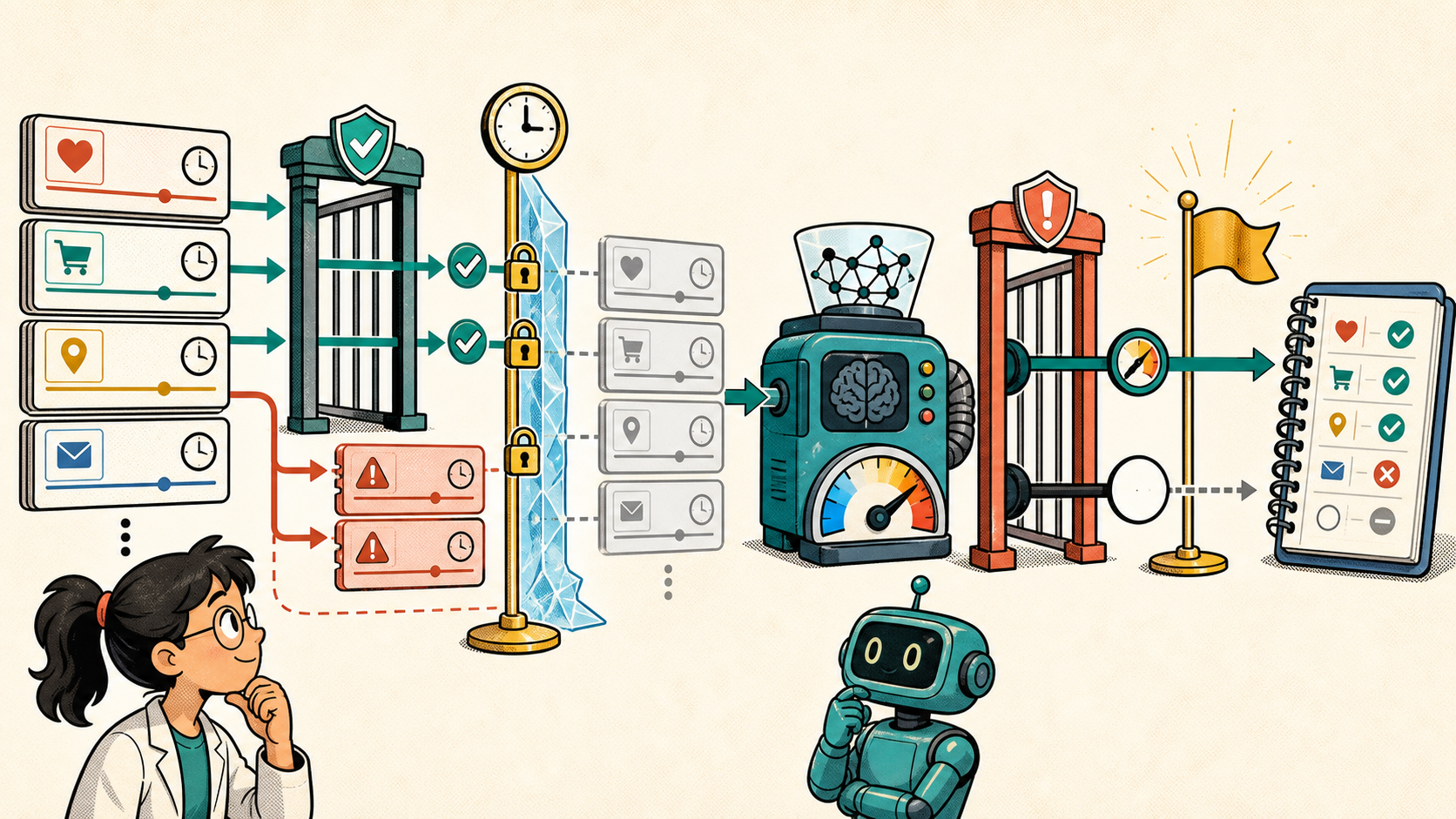
The capstone does not ask students to find a profitable signal. It asks them to construct a reproducible, time-valid, paper-trading research system and demonstrate that it refuses to operate when its evidence contract fails.
Choose one binary outcome with a written settlement contract. The contract must name the source, observation cutoff, horizon, equality rule, availability policy, and missing-data response. The label may be a synthetic teaching target if no approved historical source exists. A synthetic target is not a weakness when it is labeled honestly; it is a way to test the system’s mechanics without inventing empirical claims.
Submit one page containing the target definition, source contract, clock diagram, label equation, feature cutoff rule, missing-data policy, and examples of one eligible and one ineligible event. Two students should be able to implement the same label from this page.
Organize the work so that source capture, feature construction, training, replay, and reporting can be tested separately. A notebook may call the system, but it cannot define the system by itself. Students should still be able to reproduce a run from code, configuration, and manifest after deleting the notebook.
Every run produces an identifier and a manifest. The manifest lists code revision, environment, data partitions, feature recipe, split definition, model configuration, calibration version, replay assumptions, and test results. If any of these changes, the run is new.
Start with an immutable fixture of time-ordered events. Each event should include a source identifier, event ID, event time, receive time, schema version, and payload. Deliberately include one duplicate, one malformed record, one late record, and one unknown schema version. The validation layer must retain each record and classify it visibly.
| Test fixture event | Expected outcome | Evidence retained |
|---|---|---|
| Valid event before cutoff | Eligible for feature construction. | Event ID, cutoff, recipe input reference. |
| Event received after cutoff | Excluded from that decision row. | Receive time and exclusion reason. |
| Duplicate event | One canonical event; one duplicate record. | IDs, hash, canonical reference. |
| Unknown schema | Quarantined; no guessed mapping. | Raw payload and rejection reason. |
| Missing settlement source | Label unavailable. | Source query/fixture and label state. |
Write tests proving that a future event cannot change an earlier feature vector and that a duplicate cannot inflate a count. Also prove that an unknown schema cannot enter the model and that a missing settlement cannot be replaced with a different source.
The capstone requires comparison, not a fashionable model. Begin with a constant-probability baseline. Add a simple tabular baseline. Then train CatBoost on versioned features. If sequence fixtures or an approved sequence corpus exist, add a self-supervised encoder and causal sequence head as research challengers. Every model uses the same label, temporal split, eligibility rules, and final test.
| Candidate | Required claim | Must not claim |
|---|---|---|
| Constant baseline | Shows base-rate performance. | That a high accuracy score implies skill. |
| CatBoost | Tests nonlinear tabular interactions. | That feature importance proves causation. |
| Self-supervised encoder | Tests whether sequence representation helps downstream. | That unlabeled pretraining bypasses temporal controls. |
| Causal sequence head | Tests causal temporal patterns under a mask. | That architecture alone proves no leakage. |
For each candidate, save the training configuration, calibration configuration, model artifact hash, and a small report. If only a synthetic corpus exists, the report must say so. The correct academic result may be “the infrastructure worked; no performance claim is warranted.”
Use chronological train, purge/embargo, validation, and final-test intervals. Submit a split diagram, baseline table, confusion matrix, calibration result, and a note explaining which metric answers which question.
Use an LLM for one narrow code task, such as writing a parser test or feature-validator function. Preserve the exact task contract, generated patch, diff-review notes, and named test output. The assistant must not receive secrets or make external writes. Students must identify one plausible defect in the first generated version and show which test or review caught it.
Submit the prompt contract, assistant output or patch, human review note, test command and output, accepted revision, and a statement of what the LLM could not verify. A fluent answer without evidence earns no credit.
Build a small event-driven replay. It advances through the fixture or approved events, creates features at each cutoff, invokes the chosen model, applies policy gates, and records abstention or a hypothetical paper-trading event. The fill model may be intentionally conservative and simple, but it must be explicit. Apply delays, fees, no-fill cases, and missing settlement outcomes as declared assumptions.
Demonstrate that added latency changes at least one simulated decision or fill outcome. Demonstrate that a failed data-health or calibration gate produces abstention. Submit the immutable ledger and a sensitivity table with at least two adverse assumptions.
Implement at least three monitoring predicates: stale data, schema mismatch, and model/feature artifact mismatch. Each predicate must have a bounded automatic containment action, verification step, audit event, rollback condition, and human owner. The agent is prohibited from controlling any order or execution interface.
| Predicate | Permitted containment | Verification | Human owner |
|---|---|---|---|
| Source stale beyond budget | Stop consumer and mark policy abstain. | No new decision rows are eligible. | Data operations. |
| Unknown schema | Quarantine partition. | No quarantined ID reaches feature recipe. | Data-contract owner. |
| Artifact mismatch | Suspend candidate and block report. | Manifest mismatch appears in audit log. | Model owner. |
Run an incident fixture. Show the predicate evidence, automatic containment, audit event, verification, and escalation message. Prove by capability design and test that the monitor has no order-control function or credentials.
The final presentation is a forensic account, not a pitch. Students explain the tempting shortcut, the temporal trap they prevented, and the evidence contract. They then defend the baseline comparison, calibration and abstention decision, most damaging replay assumption, and guardian-contained incident. The strongest conclusion may be that the system found no defensible edge. That conclusion demonstrates scientific maturity.
This is a teaching capstone. It inherits the research-only and fail-closed boundaries from the safety contract and source map. No capstone result may be described as live performance or a trading recommendation.
These worksheets turn the textbook’s arguments into artifacts. A student who completes them should be able to defend a research claim, identify a broken contract, and explain why a model or agent must abstain.
Write this before obtaining results. It forces the student to separate the target from the available evidence. If any entry can be interpreted two ways, the contract is not finished.
| Operational question | What exact future binary event is estimated? |
|---|---|
| Settlement source | Which source governs the label? Why is it authoritative? |
| Start/end/horizon | Which clocks define the label window? |
| Equality rule | What happens if end equals start? |
| Decision cutoff | At what time does evidence freeze? |
| Availability rule | Which time field determines whether an event can enter features? |
| Missing/correction policy | What happens when source data is absent or revised? |
| Evidence retained | Which IDs, manifests, and versions allow a later audit? |
Challenge: Give the contract to another student. If their label builder could produce a different label from yours, identify the missing clause.
A metric report must answer a decision-relevant question. Fill the table for one model and one baseline using an untouched temporal evaluation interval. If no dataset exists, use synthetic values and label them illustrative.
| Evidence item | Student answer | Interpretation question |
|---|---|---|
| Class prevalence | _____ | Could a trivial classifier achieve a high accuracy? |
| TP / FP / TN / FN | _____ | Which error is hidden by the headline metric? |
| Accuracy | _____ | What denominator does it use? |
| Precision / recall | _____ | Which cost does each metric expose? |
| Ranking metric | _____ | Does it prove probability meaning? |
| Calibration evidence | _____ | Are 0.70-like predictions observed near 70%? |
| Baseline comparison | _____ | What information did the complex model add? |
Complete: “On the declared final interval, Model ___ differed from Baseline ___ on ___ metric. This supports the narrow claim that ___. It does not support the claim that ___.”
Draw the timeline before training, then attack it. For each transformation, ask whether it uses only earlier data. Also ask whether an overlapping window crosses a split boundary.
| Object | Lookback / horizon | Leakage risk | Control |
|---|---|---|---|
| Feature A | _____ | _____ | _____ |
| Feature B | _____ | _____ | _____ |
| Label | _____ | _____ | _____ |
| Normalizer/calibrator | _____ | _____ | _____ |
| Pretraining corpus | _____ | _____ | _____ |
Use the ladder to prevent a complex model from becoming a status symbol. Every step must beat or clarify the previous step on the same contract.
| Candidate | Hypothesis it tests | Required evidence before advancing |
|---|---|---|
| Constant baseline | What does base rate achieve? | Prevalence, accuracy, proper score. |
| Simple tabular model | Do explicit features add information? | Temporal comparison and calibration. |
| CatBoost | Do nonlinear tabular interactions help? | Same split, tuning record, calibration, failure analysis. |
| Self-supervised encoder | Does sequence representation transfer? | Pretraining boundary and downstream ablation. |
| Causal sequence head | Does causal order add useful evidence? | Future-token test, latency, fair comparison. |
| Ensemble | Are errors complementary? | Out-of-sample calibration and correlation reasoning. |
For the current candidate, write one reason to advance and one reason to stop. The stop reason must be evidence-based, not a lack of enthusiasm.
Turn assumptions into a table before looking at results. A replay becomes less flattering and more valuable when each assumption can be changed deliberately.
| Assumption | Base case | Adverse case | Expected effect |
|---|---|---|---|
| Feature/inference delay | _____ | _____ | _____ |
| Fee | _____ | _____ | _____ |
| Fill rule | _____ | _____ | _____ |
| Available size | _____ | _____ | _____ |
| Missing settlement | _____ | _____ | _____ |
After replay, add one sentence: “The conclusion is [robust / fragile / unknown] because ___.” A single attractive backtest number is not an answer.
The monitoring agent must operate from predicates, not vague intentions. Complete one card for each automatic action. Any action that changes policy, schema, model, or execution belongs in a human approval workflow.
| Predicate | What exact evidence shows the condition? |
|---|---|
| Scope | Which partition, candidate, or job is affected? |
| Automatic action | Which allowlisted reversible containment is permitted? |
| Verification | How does the system prove containment succeeded? |
| Audit event | Which inputs, identity, times, and state transitions are retained? |
| Rollback | What known safe state can be restored, by whom? |
| Escalation owner | Who decides a remediation or configuration change? |
| Forbidden action | Which authority must the agent never possess? |
Before presenting a result, label every important statement. This prevents a synthetic example, proposed architecture, or literature finding from becoming an invented local measurement.
| Label | Use it when | Example sentence starter |
|---|---|---|
| Measured | A reproducible artifact, command, or test produced the result. | “On run ___, using manifest ___, we measured …” |
| Simulated | A replay or synthetic fixture produced the result. | “Under the declared replay assumptions, the simulation …” |
| Illustrative | The example exists to explain a concept. | “For illustration, suppose …” |
| Literature-derived | A cited source supports a model or method concept. | “The cited study investigates …” |
| Design target | The system is intended but not yet demonstrated. | “The proposed system will …” |
This workbook is a teaching artifact. It inherits all boundaries from the source map, safety contract, and research replay contract. It does not establish empirical performance.
These sources support the concepts and external interfaces discussed in Signal Quest; they do not establish local performance. Recheck mutable documentation before implementation.